
Call us
301-363-4651 (Available 9 a.m. to 5 p.m. CST from Monday to Friday)

| Code | CSB-EP318417EZX-B |
| Abbreviation | Recombinant Pseudomonas aeruginosa oprF protein, Biotinylated |
| MSDS | |
| Size | $368 |
| Order now | |
| Image |
|
| Have Questions? | Leave a Message or Start an on-line Chat |
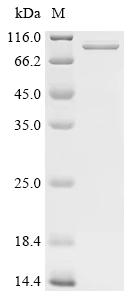
Recombinant Pseudomonas aeruginosa Outer membrane porin F (oprF), Biotinylated, gets produced in E. coli and includes an N-terminal MBP-tag along with a C-terminal 6xHis-Avi-tag for improved stability and binding capabilities. The protein spans the full length of the mature protein, covering the 25-350 amino acid region. With purity greater than 90% as determined by SDS-PAGE, this product appears suitable for various research applications that demand high-quality proteins.
Outer membrane porin F (oprF) represents a critical protein in Pseudomonas aeruginosa. It works as a channel for passive diffusion of small molecules across the bacterial outer membrane. The protein plays what seems to be a vital role in maintaining membrane integrity. It also contributes to the organism's ability to adapt in diverse environments. Researchers often examine OprF for its involvement in bacterial pathogenesis and its potential as a target for antibacterial strategies.
Potential Applications
Note: The applications listed below are based on what we know about this protein's biological functions, published research, and experience from experts in the field. However, we haven't fully tested all of these applications ourselves yet. We'd recommend running some preliminary tests first to make sure they work for your specific research goals.
Based on the provided information, the recombinant Pseudomonas aeruginosa OprF porin is expressed in E. coli, a prokaryotic system that is generally suitable for producing bacterial outer membrane proteins. OprF is a β-barrel transmembrane protein that requires precise folding and membrane integration for proper porin function. While E. coli can often correctly fold bacterial membrane proteins, the presence of large fusion tags (N-terminal MBP and C-terminal 6xHis-Avi) may significantly interfere with proper β-barrel formation and membrane insertion. The protein is expressed as the mature region (25-350aa) with biotinylation and >90% purity, but the addition of multiple tags and the absence of the native Pseudomonas membrane environment make proper folding uncertain. Since activity is unverified, the protein cannot be assumed to be correctly folded or bioactive without experimental validation of its porin function and membrane insertion capability.
1. Antibody Development and Validation Studies
The recombinant OprF can serve as an effective immunogen to generate antibodies that recognize linear epitopes, even when the protein is misfolded. The high purity supports immunization protocols. However, antibodies may not recognize conformational epitopes of native, membrane-embedded OprF. Validation against native OprF from P. aeruginosa is recommended.
2. Protein-Protein Interaction Studies
This application requires caution. While the tags enable technical feasibility for interaction studies, if OprF is misfolded or improperly inserted into membranes, it may not interact physiologically with true binding partners. The β-barrel structure requires precise conformation for specific interactions. This application should only be pursued after confirming proper folding and membrane insertion capability.
3. ELISA-Based Binding Assays
This application is feasible for detection but has limitations. The biotinylation enables technical development of ELISA assays, but if OprF is misfolded, binding measurements may not reflect native protein interactions. The assay may work for detection, but requires validation against properly folded OprF for accurate quantification of biological interactions.
4. Biochemical Characterization and Stability Studies
This application is well-suited for assessing the recombinant OprF protein itself. Techniques like circular dichroism spectroscopy and size-exclusion chromatography can evaluate the protein's folding state and stability. However, these will characterize the soluble fusion protein and may not reflect the behavior of native, membrane-embedded OprF.
Final Recommendation & Action Plan
Given the potential issues with proper folding of this β-barrel membrane protein with large fusion tags, we recommend first performing biophysical characterization to assess folding quality. This should include circular dichroism spectroscopy to verify the expected β-sheet content characteristic of porins, and size-exclusion chromatography to analyze oligomeric state. Antibody development can proceed as the safest application. For functional studies (interactions, binding assays), first confirm proper folding and consider reconstituting the protein into lipid membranes to validate porin activity. Always include appropriate controls, such as native OprF from P. aeruginosa when possible.
There are currently no reviews for this product.
KEGG: pae:PA1777
STRING: 208964.PA1777





