CD53 Recombinant Monoclonal Antibody

Code CSB-RA439535A0HU
Size US$210
Order now
Image
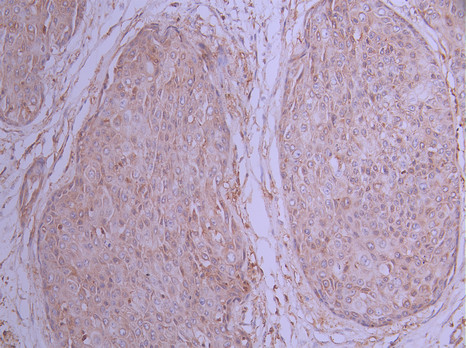
  • IHC image of CSB-RA439535A0HU diluted at 1:100 and staining in paraffin-embedded human pancreatic cancer performed on a Leica BondTM system. After dewaxing and hydration, antigen retrieval was mediated by high pressure in a citrate buffer (pH 6.0). Section was blocked with 10% normal goat serum 30min at RT. Then primary antibody (1% BSA) was incubated at 4°C overnight. The primary is detected by a Goat anti-rabbit polymer IgG labeled by HRP and visualized using 0.05% DAB.
Have Questions? Leave a Message or Start an on-line Chat

Product Details

Uniprot No.
Target Names
Alternative Names
Leukocyte surface antigen CD53 (Cell surface glycoprotein CD53) (Tetraspanin-25) (Tspan-25) (CD antigen CD53), CD53, MOX44 TSPAN25
Species Reactivity
Human
Immunogen
A synthesized peptide from human CD53 protein
Immunogen Species
Homo sapiens (Human)
Conjugate
Non-conjugated
Clonality
Monoclonal
Isotype
Rabbit IgG
Clone No.
7F6
Purification Method
Affinity-chromatography
Concentration
It differs from different batches. Please contact us to confirm it.
Buffer
Rabbit IgG in 10mM phosphate buffered saline , pH 7.4, 150mM sodium chloride, 0.05% BSA, 0.02% sodium azide and 50% glycerol.
Form
Liquid
Tested Applications
ELISA, IHC
Recommended Dilution
Application Recommended Dilution
IHC 1:50-1:200
Troubleshooting and FAQs
Storage
Upon receipt, store at -20°C or -80°C. Avoid repeated freeze.
Lead Time
Basically, we can dispatch the products out in 1-3 working days after receiving your orders. Delivery time maybe differs from different purchasing way or location, please kindly consult your local distributors for specific delivery time.
Description

CD53 is a member of the tetraspanin superfamily, a group of transmembrane proteins that organize membrane microdomains and regulate diverse cellular processes including adhesion, migration, and signal transduction. Expressed predominantly on leukocytes, CD53 plays important roles in immune cell function and has been implicated in lymphocyte activation, T cell co-stimulation, and inflammatory responses. Its involvement in immune regulation makes it a valuable target for researchers investigating hematological malignancies, autoimmune conditions, and the tumor microenvironment.

This recombinant monoclonal antibody, clone 7F6, offers the consistency and reliability that demanding research applications require. Produced using recombinant technology with a sequence-defined rabbit IgG framework, it eliminates the lot-to-lot variability that can compromise longitudinal studies and reproducibility. The antibody was raised against a synthetic peptide derived from human CD53, ensuring precise epitope targeting.

Validation in immunohistochemistry demonstrates clear performance in paraffin-embedded human pancreatic cancer tissue, where the antibody was tested at 1:100 dilution using a standard citrate buffer antigen retrieval protocol. This validation in tumor tissue is particularly relevant for researchers examining CD53 expression patterns in cancer contexts or investigating immune cell infiltration within the tumor microenvironment. The recommended working dilution range of 1:50-1:200 for IHC provides flexibility for optimization across different tissue types and detection systems.

Whether you are characterizing leukocyte populations in tissue sections, exploring tetraspanin biology in cancer research, or investigating immune cell dynamics, this antibody provides a dependable tool for advancing your understanding of CD53 function in human samples.

Usage
For Research Use Only. Not for use in diagnostic or therapeutic procedures.

Customer Reviews and Q&A

 Customer Reviews

There are currently no reviews for this product.

Submit a Review here

Target Background

Function
Required for efficient formation of myofibers in regenerating muscle at the level of cell fusion. May be involved in growth regulation in hematopoietic cells.
Gene References into Functions
  1. In this study, significant and lineage-dependent association of CD53 locus with Tuberculosis (TB) onset was identified from the pathogen lineage-based genome-wide association study (GWAS). PMID: 28878339
  2. CD53 is associated with population asthma risk via the functional promoter polymorphism -1560 C>T. PMID: 23313165
  3. SNP rs6679497 in gene CD53 showed significant association with TNFalpha levels (P=0.001); no association of this SNP was observed with osteoarthritis PMID: 20407468
  4. Ligation of CD53 triggers a survival response and reduces the number of cells that enter apoptosis. The CD53 antigen interactions might contribute to cell survival in poorly vascularized regions of the tumor mass. PMID: 12606948
  5. Analysis of lymphocyte subsets showed that the total number of CD3+, CD4+, CD8+ and CD56+ lymphocytes increased after the intensive protocol before falling below pre-exercise values at 1 h post-exercise. PMID: 16506060
  6. The paradox is that lymphocytes from RA patients are believed to resist apoptosis, and we suggest that the elevated expression of CD53, which results from the increased oxidative stress, may protect against apoptosis. PMID: 17210617

Show More

Hide All

Subcellular Location
Cell membrane. Cell junction. Membrane; Multi-pass membrane protein.
Protein Families
Tetraspanin (TM4SF) family
Tissue Specificity
B-cells, monocytes, macrophages, neutrophils, single (CD4 or CD8) positive thymocytes and peripheral T-cells.
Database Links

HGNC: 1686

OMIM: 151525

KEGG: hsa:963

STRING: 9606.ENSP00000271324

UniGene: Hs.443057

icon of phone
Call us
301-363-4651 (Available 9 a.m. to 5 p.m. CST from Monday to Friday)

icon of address
Address
No. 269, Shendun 5th Road, Donghu Hi-Tech Development Area, Hubei Province, 430206, P.R.China
icon of social media
Join us with

Subscribe newsletter

Leave a message

* To protect against spam, please pass the CAPTCHA test below.
CAPTCHA verification
© 2007-2026 CUSABIO TECHNOLOGY LLC All rights reserved. 鄂ICP备15011166号-1
Place an order now

I. Product details

*
*
*
*

II. Contact details

*
*

III. Ship To

*
*
*
*
*
*
*

IV. Bill To

*
*
*
*
*
*
*
*


