
Call us
301-363-4651 (Available 9 a.m. to 5 p.m. CST from Monday to Friday)

| Code | CSB-RA291625A0HU |
| Size | US$210 |
| Order now | |
| Image |
|
| Have Questions? | Leave a Message or Start an on-line Chat |
| Application | Recommended Dilution |
|---|---|
| FC | 1:50-1:200 |
The cadherin family of calcium-dependent cell adhesion molecules plays fundamental roles in tissue morphogenesis, epithelial integrity, and cell-cell communication. This antibody recognizes multiple cadherin family members including E-cadherin (CDH1), N-cadherin (CDH2), P-cadherin (CDH3), VE-cadherin (CDH5), and R-cadherin (CDH4), making it a versatile tool for researchers investigating adhesion dynamics across different tissue contexts. E-cadherin in particular serves as a critical marker in epithelial-to-mesenchymal transition studies, while the broader cadherin family influences processes ranging from neural development to vascular permeability.
Developed using recombinant monoclonal technology, this rabbit IgG antibody offers the reproducibility that demanding experimental workflows require. Unlike traditional hybridoma-derived antibodies, recombinant production ensures sequence-defined consistency between lots, eliminating a common source of experimental variability that can complicate longitudinal studies or multi-site collaborations.
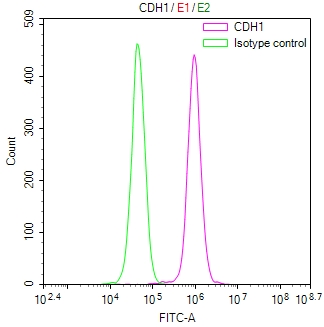
This antibody has been validated for flow cytometry applications, with recommended dilutions ranging from 1:50 to 1:200. Validation studies using MCF-7 human breast cancer cells demonstrated clear positive signal separation from isotype control, with cells fixed in formaldehyde and permeabilized with Triton X-100 to enable intracellular epitope access. The antibody is also suitable for ELISA-based detection methods.
Supplied in a phosphate-buffered saline solution containing BSA and glycerol for stability, this unconjugated format provides flexibility for researchers to pair with their preferred secondary detection systems. The ability to detect multiple cadherin family members makes this antibody particularly valuable for cancer biology research, developmental studies, and investigations into tissue barrier function where cadherin switching or expression changes serve as key experimental readouts.
There are currently no reviews for this product.





