
Call us
301-363-4651 (Available 9 a.m. to 5 p.m. CST from Monday to Friday)

| Code | CSB-RA843881A0HU |
| Size | US$210 |
| Order now | |
| Image |
|
| Have Questions? | Leave a Message or Start an on-line Chat |
| Application | Recommended Dilution |
|---|---|
| FC | 1:50-1:200 |
Cathepsin D is a lysosomal aspartyl protease that plays essential roles in protein degradation, autophagy, and apoptotic signaling pathways. This enzyme has garnered significant research attention due to its involvement in neurodegenerative conditions, including ceroid lipofuscinosis neuronal 10, as well as its established connections to cancer progression and metastasis. Understanding cathepsin D expression and activity provides valuable insights into cellular homeostasis and disease mechanisms.
This recombinant monoclonal antibody, clone 14D2, offers researchers the reproducibility and consistency that recombinant technology provides. Because the antibody sequence is defined and produced in a controlled expression system, you can expect reliable performance across experiments and between lot numbers, eliminating the variability often encountered with traditional hybridoma-derived antibodies. The rabbit host and IgG isotype, combined with affinity chromatography purification, ensure high specificity for your target.
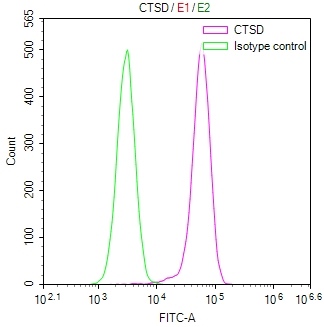
Validation studies confirm this antibody's utility in flow cytometry applications, with recommended dilutions ranging from 1:50 to 1:200. Flow cytometric analysis using 786-O renal carcinoma cells demonstrated clear detection of cathepsin D, with the antibody producing a distinct positive signal compared to isotype control when cells were fixed and permeabilized. This intracellular staining protocol successfully detected the lysosomal protease at 1:100 dilution, providing a reliable starting point for your optimization. The antibody is also validated for ELISA, offering flexibility for quantitative detection workflows.
This CTSD antibody serves researchers investigating lysosomal biology, autophagy regulation, neurodegeneration, and cancer cell biology, providing a dependable tool for characterizing cathepsin D expression in human samples.
There are currently no reviews for this product.





