
Call us
301-363-4651 (Available 9 a.m. to 5 p.m. CST from Monday to Friday)

| Code | CSB-RA153094A0HU |
| Size | US$210 |
| Order now | |
| Image |
|
| Have Questions? | Leave a Message or Start an on-line Chat |
| Application | Recommended Dilution |
|---|---|
| FC | 1:50-1:200 |
Beta-defensin 1 (DEFB1) serves as a critical component of the innate immune system, functioning as an antimicrobial peptide that provides first-line defense against bacterial, fungal, and viral pathogens at epithelial surfaces. Constitutively expressed in various tissues including the respiratory tract, urogenital system, and kidneys, DEFB1 plays an essential role in maintaining mucosal immunity and has garnered significant research interest for its involvement in host defense mechanisms and inflammatory responses.
This recombinant monoclonal antibody, clone 1F5, offers researchers the reproducibility and consistency that only sequence-defined antibodies can provide. Generated against a synthetic peptide derived from human DEFB1 and produced in rabbit host, the recombinant format ensures that every lot performs identically to the last, eliminating the variability concerns that can compromise longitudinal studies or multi-site collaborations. Affinity chromatography purification further enhances specificity and reduces background interference in sensitive assays.
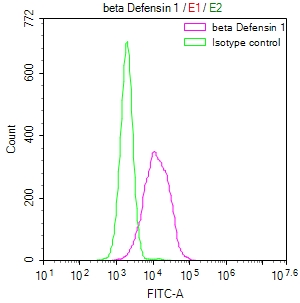
Validation studies confirm reliable performance in flow cytometry applications, with recommended dilutions of 1:50 to 1:200. Flow cytometric analysis using HepG2 cells demonstrates clear positive signal separation from isotype control, with surface staining performed at 1 microgram per million cells. This validation in a human hepatocellular carcinoma cell line provides researchers with a reference point for optimizing detection in their own experimental systems. The antibody is also validated for ELISA applications, offering flexibility across different experimental workflows.
For investigators studying innate immunity, antimicrobial peptide biology, or mucosal defense mechanisms, this DEFB1 antibody provides a dependable tool for characterizing defensin expression patterns in human samples.
There are currently no reviews for this product.





