
Call us
301-363-4651 (Available 9 a.m. to 5 p.m. CST from Monday to Friday)

| Code | CSB-RA274766A0HU |
| Size | US$210 |
| Order now | |
| Image |
|
| Have Questions? | Leave a Message or Start an on-line Chat |
| Application | Recommended Dilution |
|---|---|
| FC | 1:50-1:200 |
ERG is a transcription factor belonging to the ETS family that plays critical roles in vascular development, hematopoiesis, and bone formation. In cancer research, ERG has gained particular prominence due to its involvement in chromosomal translocations, most notably the TMPRSS2-ERG fusion found in approximately half of all prostate cancers. This fusion event drives oncogenic signaling and represents both a diagnostic marker and therapeutic target, making reliable ERG detection essential for researchers investigating prostate cancer biology, leukemia, and vascular endothelial function.
This recombinant monoclonal antibody, clone 3G7, offers the consistency and reproducibility that demanding research applications require. Generated against a synthetic peptide derived from human ERG and produced using recombinant technology in rabbit host, this antibody provides sequence-defined specificity with minimal lot-to-lot variation. This reliability is particularly valuable when establishing long-term studies or when comparing results across multiple experiments over time.
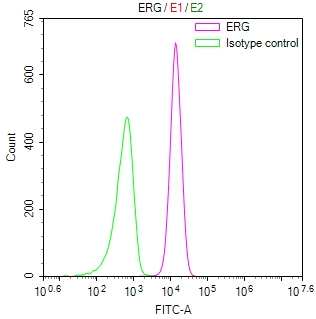
The antibody has been validated for flow cytometry applications, with testing in Jurkat cells demonstrating clear positive signal separation from isotype control. The validation protocol employed standard intracellular staining conditions using formaldehyde fixation and Triton X-100 permeabilization, confirming the antibody's utility for detecting nuclear transcription factors in fixed and permeabilized samples. Recommended dilutions for flow cytometry range from 1:50 to 1:200, allowing researchers flexibility to optimize signal-to-noise ratios for their specific experimental conditions.
This ERG antibody serves researchers studying prostate cancer progression, endothelial cell biology, and hematopoietic malignancies where accurate transcription factor detection is fundamental to understanding disease mechanisms and evaluating potential therapeutic interventions.
There are currently no reviews for this product.





