FBL Recombinant Monoclonal Antibody

Code CSB-RA097605A0HU
Size US$210
Order now
Image
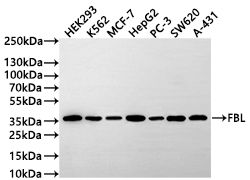
  • Western Blot
    Positive WB detected in: HEK293 whole cell lysate(30µg), K562 whole cell lysate(30µg), MCF-7 whole cell lysate(30µg), HepG2 whole cell lysate(30µg), PC-3 whole cell lysate(30µg), SW620 whole cell lysate(30µg), A-431 whole cell lysate(30µg)
    All lanes: FBL antibody at 1:1000
    Secondary
    Goat polyclonal to rabbit IgG at 1/50000 dilution
    Predicted band size: 34 kDa
    Observed band size: 36 kDa
    Exposure time: 3min
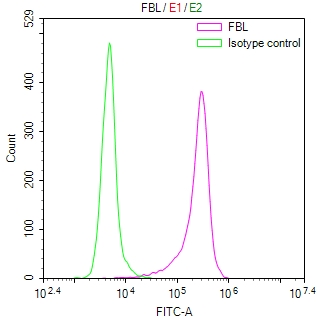
  • Overlay Peak curve showing PC-3 cells stained with CSB-RA097605A0HU (red line) at 1:100. The cells were fixed in 4% formaldehyde and permeated by 0.2% TritonX-100 for 10min. Then 10% normal goat serum to block non-specific protein-protein interactions followed by the antibody (1ug/1*106cells) for 45min at 4℃. The secondary antibody used was FITC-conjugated goat anti-rabbit IgG (H+L) at 1/200 dilution for 35min at 4℃.Control antibody (green line) was Rabbit IgG (1ug/1*106cells) used under the same conditions. Acquisition of >10,000 events was performed.
Have Questions? Leave a Message or Start an on-line Chat

Product Details

Uniprot No.
Target Names
Alternative Names
34 kD nucleolar scleroderma antigen antibody; 34 kDa nucleolar scleroderma antigen antibody; Fbl antibody; FBRL_HUMAN antibody; FIB antibody; FIB1 antibody; FLRN antibody; Histone-glutamine methyltransferase antibody; Nop1p antibody; RNA U3 small nucleolar interacting protein 1 antibody; RNU3IP1 antibody; rRNA 2' O methyltransferase fibrillarin antibody; rRNA 2'-O-methyltransferase fibrillarin antibody
Species Reactivity
Human
Immunogen
A synthesized peptide derived from human FBL
Immunogen Species
Homo sapiens (Human)
Conjugate
Non-conjugated
Clonality
Monoclonal
Isotype
Rabbit IgG
Clone No.
2F1
Purification Method
Affinity-chromatography
Concentration
It differs from different batches. Please contact us to confirm it.
Buffer
Rabbit IgG in 10mM phosphate buffered saline , pH 7.4, 150mM sodium chloride, 0.05% BSA, 0.02% sodium azide and 50% glycerol.
Form
Liquid
Tested Applications
ELISA, WB, FC
Recommended Dilution
Application Recommended Dilution
WB 1:500-1:2000
FC 1:50-1:200
Troubleshooting and FAQs
Storage
Upon receipt, store at -20°C or -80°C. Avoid repeated freeze.
Lead Time
Basically, we can dispatch the products out in 1-3 working days after receiving your orders. Delivery time maybe differs from different purchasing way or location, please kindly consult your local distributors for specific delivery time.
Description

Fibrillarin (FBL) serves as a critical nucleolar methyltransferase responsible for 2'-O-methylation of ribosomal RNA, a modification essential for proper ribosome assembly and function. As a core component of small nucleolar ribonucleoprotein complexes, FBL plays fundamental roles in ribosome biogenesis and has emerged as a significant marker in studies of nucleolar stress, cell proliferation, and autoimmune disease research, where it was originally identified as a scleroderma autoantigen.

This recombinant monoclonal antibody, clone 2F1, offers the reproducibility and consistency that demanding experimental workflows require. Developed using recombinant technology with a sequence-defined rabbit IgG format, this antibody eliminates the lot-to-lot variability that can compromise longitudinal studies and multi-site collaborations. The defined molecular composition ensures that your results remain comparable across experiments and publications.

Validation testing demonstrates robust performance across multiple applications. In western blot analysis, the antibody reliably detects FBL across a diverse panel of human cell lines including HEK293, K562, MCF-7, HepG2, PC-3, SW620, and A-431, with effective detection at dilutions ranging from 1:500 to 1:2000. The observed ~36 kDa band is slightly larger than the predicted 34 kDa likely due to common SDS-PAGE migration rate variations or the presence of post-translational modifications (such as methylation or phosphorylation) inherent to this nucleolar protein. Flow cytometry validation in PC-3 cells confirms the antibody's utility for single-cell analysis of FBL expression, with recommended dilutions between 1:50 and 1:200.

Whether investigating ribosome biogenesis, nucleolar dynamics, or exploring FBL as a proliferation marker in cancer research, this antibody provides the reliable detection needed for meaningful experimental outcomes.

Usage
For Research Use Only. Not for use in diagnostic or therapeutic procedures.

Customer Reviews and Q&A

 Customer Reviews

There are currently no reviews for this product.

Submit a Review here

Target Background

Function
S-adenosyl-L-methionine-dependent methyltransferase that has the ability to methylate both RNAs and proteins. Involved in pre-rRNA processing by catalyzing the site-specific 2'-hydroxyl methylation of ribose moieties in pre-ribosomal RNA. Site specificity is provided by a guide RNA that base pairs with the substrate. Methylation occurs at a characteristic distance from the sequence involved in base pairing with the guide RNA. Probably catalyzes 2'-O-methylation of U6 snRNAs in box C/D RNP complexes. U6 snRNA 2'-O-methylation is required for mRNA splicing fidelity. Also acts as a protein methyltransferase by mediating methylation of 'Gln-105' of histone H2A (H2AQ104me), a modification that impairs binding of the FACT complex and is specifically present at 35S ribosomal DNA locus.
Gene References into Functions
  1. Fibrillarin acts as a central node in a regulatory network engaged in imparting immunity against bacterial pathogens. PMID: 30190478
  2. Nucleolar Methyltransferase Fibrillarin: Evolution of Structure and Functions. PMID: 27682166
  3. FBL overexpression contributes to tumorigenesis and is associated with poor survival in patients with breast cancer. PMID: 24029231
  4. NS1 protein of the human H3N2 virus interacts primarily via the C-terminal NLS2/NoLS and to a minor extent via the N-terminal NLS1 with the main nucleolar proteins, nucleolin, B23 and fibrillarin. PMID: 22909121
  5. p32 is a new rRNA maturation factor involved in the remodeling from pre-90S particles to pre-40S and pre-60S particles that requires the exchange of FBL for Nop52. PMID: 21536856
  6. Increased levels of exogenous BRAG2 in nucleoli result in redistribution of FBL to the nucleolar periphery. PMID: 17461797
  7. Our data suggest that fibrillarin would play a critical role in the maintenance of nuclear shape and cellular growth. PMID: 17603021
  8. Evidence that BIG1 and nucleolin, but not fibrillarin, can be present with p62 at the nuclear envelope confirms the presence of BIG1 and nucleolin in dynamic molecular complexes that change in composition while moving through nuclei PMID: 18292223
  9. Data demonstrate that fibrillarin and Nop56 directly interact in vivo, and that this interaction is indispensable for the association of both proteins with the box C/D snoRNPs. PMID: 19331828

Show More

Hide All

Subcellular Location
Nucleus, nucleolus. Nucleus, nucleoplasm. Note=Fibrillar region of the nucleolus.
Protein Families
Methyltransferase superfamily, Fibrillarin family
Database Links

HGNC: 3599

OMIM: 134795

KEGG: hsa:2091

STRING: 9606.ENSP00000221801

UniGene: Hs.299002

icon of phone
Call us
301-363-4651 (Available 9 a.m. to 5 p.m. CST from Monday to Friday)

icon of address
Address
No. 269, Shendun 5th Road, Donghu Hi-Tech Development Area, Hubei Province, 430206, P.R.China
icon of social media
Join us with

Subscribe newsletter

Leave a message

* To protect against spam, please pass the CAPTCHA test below.
CAPTCHA verification
© 2007-2026 CUSABIO TECHNOLOGY LLC All rights reserved. 鄂ICP备15011166号-1
Place an order now

I. Product details

*
*
*
*

II. Contact details

*
*

III. Ship To

*
*
*
*
*
*
*

IV. Bill To

*
*
*
*
*
*
*
*


