FGF13 Recombinant Monoclonal Antibody

Code CSB-RA008619MA1HU
Size US$210
Order now
Image
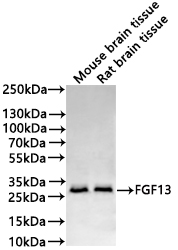
  • Western Blot
    Positive WB detected in: Mouse Brain tissue lysate(30µg), Rat brain tissue lysate(30µg)
    All lanes: FGF13 antibody at 1:1000
    Secondary
    Goat polyclonal to human IgG at 1/40000 dilution
    Predicted band size: 28 kDa
    Observed band size: 28 kDa
    Exposure time: 2min
Have Questions? Leave a Message or Start an on-line Chat

Product Details

Uniprot No.
Target Names
FGF13
Alternative Names
FGF 13 antibody; FGF 2 antibody; FGF-13 antibody; FGF13 antibody; FGF13_HUMAN antibody; FGF2 antibody; FHF 2 antibody; FHF-2 antibody; FHF2 antibody; Fibroblast growth factor 13 antibody; Fibroblast growth factor homologous factor 2 antibody; OTTHUMP00000024143 antibody; OTTHUMP00000024144 antibody
Species Reactivity
Human, Mouse, Rat
Immunogen
Recombinant Human FGF13 protein
Immunogen Species
Homo sapiens (Human)
Conjugate
Non-conjugated
Clonality
Monoclonal
Isotype
hIgG1
Clone No.
14B1
Purification Method
Affinity-chromatography
Concentration
It differs from different batches. Please contact us to confirm it.
Buffer
Preservative: 0.03% Proclin 300
Constituents: 50% Glycerol, 0.01M PBS, PH 7.4
Form
Liquid
Tested Applications
ELISA, WB
Recommended Dilution
Application Recommended Dilution
WB 1:500-1:2000
Troubleshooting and FAQs
Storage
Upon receipt, store at -20°C or -80°C. Avoid repeated freeze.
Lead Time
Basically, we can dispatch the products out in 1-3 working days after receiving your orders. Delivery time maybe differs from different purchasing way or location, please kindly consult your local distributors for specific delivery time.
Description

Fibroblast growth factor 13, also known as FGF homologous factor 2, represents a distinctive member of the FGF family that functions as an intracellular signaling molecule rather than a secreted growth factor. FGF13 plays critical roles in neuronal development and function, where it modulates voltage-gated sodium channel activity and influences microtubule dynamics essential for proper neuronal migration and axon formation. These functions make FGF13 a compelling target for researchers investigating neurodevelopmental processes, ion channel regulation, and related neurological disorders.

This recombinant monoclonal antibody, clone 14B1, offers the reproducibility and consistency that demanding experimental workflows require. Because recombinant antibodies are produced from defined sequences rather than traditional hybridoma methods, researchers benefit from lot-to-lot uniformity that supports reliable data across extended studies and collaborative projects. The human IgG1 format and affinity chromatography purification ensure high specificity for your target detection needs.

Validation studies demonstrate robust performance in Western blot applications, where the antibody successfully detects FGF13 at the expected molecular weight of 28 kDa in both mouse and rat brain tissue lysates at dilutions ranging from 1:500 to 1:2000. This cross-species reactivity across human, mouse, and rat samples provides flexibility for researchers working with multiple model systems in neuroscience and signal transduction studies. The antibody is also validated for ELISA applications, expanding its utility across different experimental platforms.

Whether you are investigating FGF13's role in neuronal signaling, exploring its interactions with sodium channels, or examining broader signal transduction pathways, this antibody delivers the specificity and consistency needed for meaningful experimental results.

Usage
For Research Use Only. Not for use in diagnostic or therapeutic procedures.

Customer Reviews and Q&A

 Customer Reviews

There are currently no reviews for this product.

Submit a Review here

Target Background

Function
Microtubule-binding protein which directly binds tubulin and is involved in both polymerization and stabilization of microtubules. Through its action on microtubules, may participate in the refinement of axons by negatively regulating axonal and leading processes branching. Plays a crucial role in neuron polarization and migration in the cerebral cortex and the hippocampus. May regulate voltage-gated sodium channels transport and function. May also play a role in MAPK signaling. Required for the development of axonal initial segment-targeting inhibitory GABAergic synapses made by chandelier neurons.
Gene References into Functions
  1. The present study reported the presence of FGF13 in the follicular fluid of women undergoing IVF/ICSI. Moreover, the relationships between FF-FGF13 and FF-TT, ovarian morphology and oocyte developmental competence imply that FF-FGF13 might be involved in the pathophysiological process of polycystic ovary syndrome. PMID: 30257687
  2. Autism-related protein MeCP2 regulates FGF13 expression and emotional behaviors PMID: 27916441
  3. FGF13 was downregulated in human placentae with early-onset preeclampsia. FGF13 played an important role in maintaining placental trophoblast permeability via the modulation of E-cadherin. PMID: 29405966
  4. We propose that, in cells in which activated oncogenes drive excessive protein synthesis, FGF13 may favor survival by maintaining translation rates at a level compatible with the protein quality-control capacity of the cell. Thus, FGF13 may serve as an enabler, allowing cancer cells to evade proteostasis stress triggered by oncogene activation. PMID: 27994142
  5. Study screened the coding and splice site regions of the FGF13 gene in a sample of 45 unrelated probands where genetic epilepsy with febrile seizures plus segregated in an X-linked pattern; subsequently identified a de novo FGF13 missense variant in an additional patient with febrile seizures and facial edema. Results suggest that FGF13 is not a common cause of genetic epilepsy with febrile seizures plus. PMID: 27810516
  6. identified two novel native phosphorylation sites in the C terminus of NaV1.5 that impair FGF13-dependent regulation of channel inactivation and may contribute to CaMKIIdeltac-dependent arrhythmogenic disorders in failing hearts. PMID: 28882890
  7. These data showed the diversity of the roles of the FGF13 N-termini in NaV1.5 channel modulation and suggested the importance of isoform-specific regulation PMID: 27246624
  8. the FGF13/Nav1.7 complex is essential for sustaining the transmission of noxious heat signals PMID: 28162808
  9. for PCa patients after RP, FGF13 serves as a potential novel prognostic marker that improves prediction of BCR-free survival, in particular if combined with other clinical parameters. PMID: 26891277
  10. The findings of this study reveal a novel cause of this syndrome and underscore the powerful role of FGF13 in control of neuronal excitability. PMID: 26063919
  11. X-chromosome deletions may be a cause of WS with larger deletions being lethal to males and that FGF13 mutations may be a cause of Wildervanck Syndrome (WS). PMID: 23373430
  12. Upregulated expression of FGF13/FHF2 mediates resistance to platinum drugs in cervical cancer cells PMID: 24113164
  13. FGF13 has a role in hair follicle growth and in the hair cycle as shown in a family with X-linked congenital generalized hypertrichosis PMID: 23603273
  14. interactions with perlecans PMID: 11847221
  15. identification of a domain controlling angiogenic properties PMID: 12496262
  16. FHF2B is an interacting partner of Na(v)1.6. The preferential expression of FHF2B in sensory neurons may provide a basis for physiological differences in sodium currents that have been reported at the nodes of Ranvier in sensory versus motor axons. PMID: 15282281

Show More

Hide All

Subcellular Location
Cell projection, filopodium. Cell projection, growth cone. Cell projection, dendrite. Nucleus. Cytoplasm.; [Isoform 1]: Nucleus, nucleolus.; [Isoform 2]: Cytoplasm. Nucleus.
Protein Families
Heparin-binding growth factors family
Tissue Specificity
Ubiquitously expressed. Predominantly expressed in the nervous system.
Database Links

HGNC: 3670

OMIM: 300070

KEGG: hsa:2258

STRING: 9606.ENSP00000359635

UniGene: Hs.6540

icon of phone
Call us
301-363-4651 (Available 9 a.m. to 5 p.m. CST from Monday to Friday)

icon of address
Address
No. 269, Shendun 5th Road, Donghu Hi-Tech Development Area, Hubei Province, 430206, P.R.China
icon of social media
Join us with

Subscribe newsletter

Leave a message

* To protect against spam, please pass the CAPTCHA test below.
CAPTCHA verification
© 2007-2026 CUSABIO TECHNOLOGY LLC All rights reserved. 鄂ICP备15011166号-1
Place an order now

I. Product details

*
*
*
*

II. Contact details

*
*

III. Ship To

*
*
*
*
*
*
*

IV. Bill To

*
*
*
*
*
*
*
*


