FILIP1L Recombinant Monoclonal Antibody

Code CSB-RA679703MA1HU
Size US$210
Order now
Image
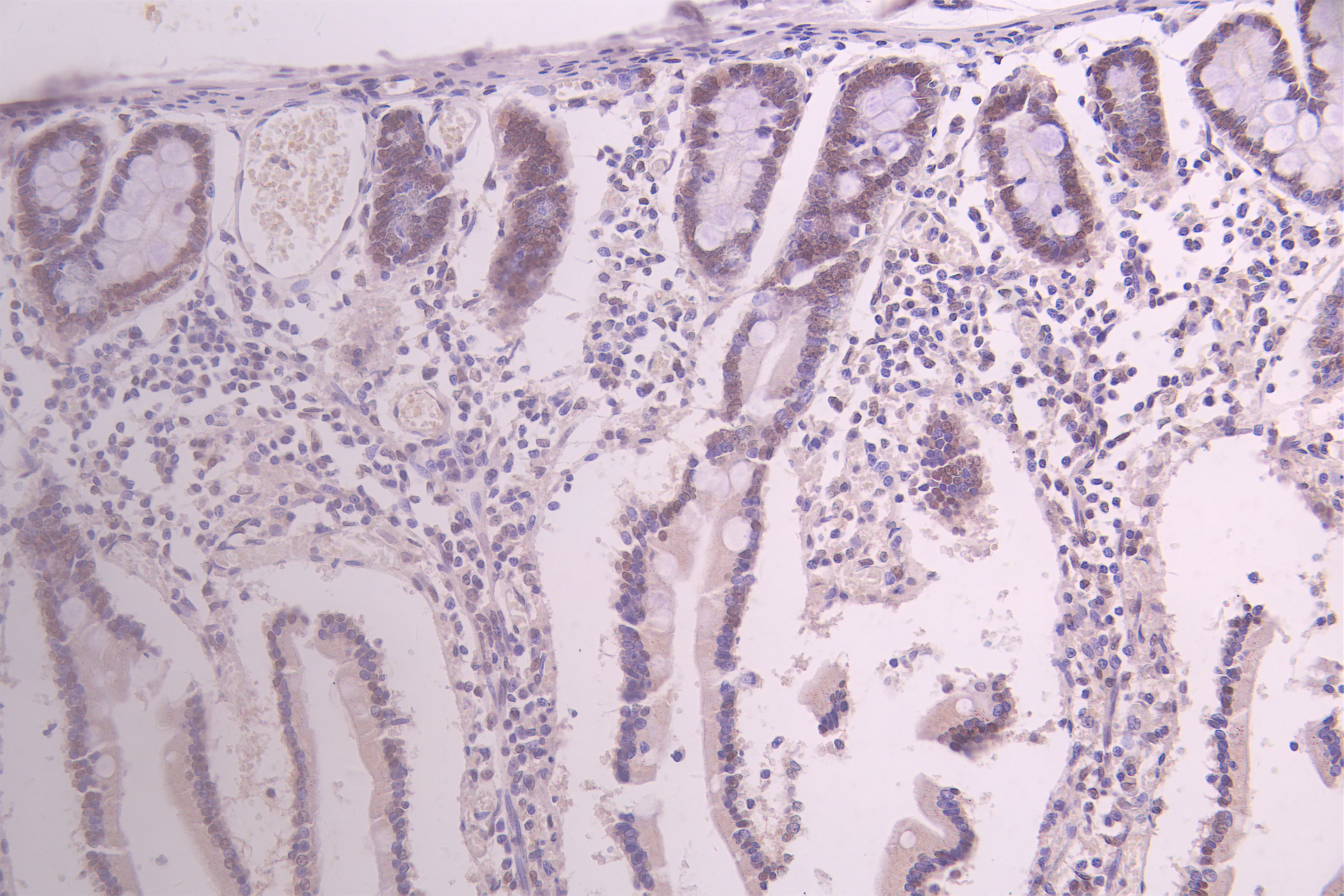
  • IHC image of CSB-RA679703MA1HU diluted at 1:100 and staining in paraffin-embedded human small intestine tissue performed on a Leica BondTM system. After dewaxing and hydration, antigen retrieval was mediated by high pressure in a citrate buffer (pH 6.0). Section was blocked with 10% normal goat serum 30min at RT. Then primary antibody (1% BSA) was incubated at 4°C overnight. The primary is detected by a Goat anti-human polymer IgG labeled by HRP and visualized using 0.05% DAB.
Have Questions? Leave a Message or Start an on-line Chat

Product Details

Uniprot No.
Target Names
FILIP1L
Alternative Names
130 kDa GPBP-interacting protein antibody; 90 kDa GPBP-interacting protein antibody; COL4A3BPIP antibody; DOC-1 antibody; DOC1 antibody; Downregulated in ovarian cancer 1 81 kDa isoform antibody; FIL1L_HUMAN antibody; Filamin A-interacting protein 1-like antibody; FILIP1L antibody; GIP130 antibody; GIP130a antibody; GIP130b antibody; GIP130c antibody; GIP90 antibody; GPBP interacting protein 90 antibody; Protein down-regulated in ovarian cancer 1 antibody
Species Reactivity
Human
Immunogen
Recombinant Human FILIP1L protein
Immunogen Species
Homo sapiens (Human)
Conjugate
Non-conjugated
Clonality
Monoclonal
Isotype
hIgG1
Clone No.
4H7G5
Purification Method
Affinity-chromatography
Concentration
It differs from different batches. Please contact us to confirm it.
Buffer
Preservative: 0.03% Proclin 300
Constituents: 50% Glycerol, 0.01M PBS, PH 7.4
Form
Liquid
Tested Applications
ELISA, IHC
Recommended Dilution
Application Recommended Dilution
IHC 1:50-1:200
Troubleshooting and FAQs
Storage
Upon receipt, store at -20°C or -80°C. Avoid repeated freeze.
Lead Time
Basically, we can dispatch the products out in 1-3 working days after receiving your orders. Delivery time maybe differs from different purchasing way or location, please kindly consult your local distributors for specific delivery time.
Description

FILIP1L, also known as Downregulated in Ovarian Cancer 1 (DOC-1), represents a compelling target for researchers investigating tumor suppression mechanisms and cytoskeletal regulation. This protein interacts with filamin A and GPBP, positioning it at the intersection of cell adhesion, migration, and cancer biology. Its documented downregulation in ovarian cancer has made it a focus for studies exploring tumor progression and potential therapeutic targets.

This recombinant monoclonal antibody, clone 4H7G5, offers the consistency and reliability that demanding research protocols require. Generated against recombinant human FILIP1L protein and produced using recombinant technology with a human IgG1 framework, this antibody delivers sequence-defined specificity that eliminates the lot-to-lot variability often encountered with traditional hybridoma-derived reagents. Researchers can confidently incorporate this antibody into long-term studies knowing that performance characteristics will remain stable across multiple experiments.

Validation through immunohistochemistry demonstrates effective performance in paraffin-embedded human tissues. Testing in human small intestine tissue sections using a citrate buffer antigen retrieval protocol at pH 6.0 confirms reliable detection at dilutions ranging from 1:50 to 1:200, providing flexibility to optimize staining intensity for different tissue contexts. The antibody has also been validated for ELISA applications, expanding its utility across complementary detection platforms.

Supplied in a stabilizing buffer containing 50% glycerol and PBS at pH 7.4, this affinity-purified antibody maintains activity when stored at -20°C or -80°C. Whether investigating FILIP1L's role in ovarian cancer progression, exploring its interactions within the cytoskeletal network, or examining its expression patterns across human tissues, this antibody provides a dependable tool for advancing your research objectives.

Usage
For Research Use Only. Not for use in diagnostic or therapeutic procedures.

Customer Reviews and Q&A

 Customer Reviews

There are currently no reviews for this product.

Submit a Review here

Target Background

Function
Acts as a regulator of the antiangiogenic activity on endothelial cells. When overexpressed in endothelial cells, leads to inhibition of cell proliferation and migration and an increase in apoptosis. Inhibits melanoma growth When expressed in tumor-associated vasculature.
Gene References into Functions
  1. FILIP1L inhibits progression in colorectal cancer by inhibiting tumor cell proliferation and angiogenesis. PMID: 27750216
  2. Studies have shown that FILIP1L expression is related with inhibition of metastases and chemoresistance of ovarian neoplasm, which is associated with downregulation of EMT through beta-catenin degradation. FILIP1L expression correlates with significantly improved overall survival. PMID: 27776341
  3. these findings suggest that FILIP1L reduces beta-catenin levels, which may lead to the transcriptional downregulation of WNT target genes such as MMPs, resulting in inhibition of metastasis PMID: 24327474
  4. down-regulation of FILIP1L associated with DNA methylation is related with the invasive phenotype in various cancers. PMID: 24340050
  5. these findings suggest that downregulation of FILIP1L associated with DNA methylation is related with the invasive phenotype in ovarian cancer and that modulation of FILIP1L expression has the potential to be a target for ovarian cancer therapy. PMID: 21693594
  6. a novel function for FILIP-1L and a pathway for Hsf1 degradation through the ubiquitin-proteasome system. PMID: 21784850
  7. DOC1 might play a role in mediating some of the effects of EMAP-II on endothelial cells PMID: 15935955

Show More

Hide All

Subcellular Location
Cytoplasm. Membrane. Nucleus.
Protein Families
FILIP1 family
Tissue Specificity
Expressed in endothelial cells, colon and colon cancers. In the colon, expressed in the vasculature and muscularis mucosa. In colon cancer, strongly expressed in tumor stroma and the vasculature (at protein level). Expressed in ovarian epithelial cells. D
Database Links

HGNC: 24589

OMIM: 612993

KEGG: hsa:11259

STRING: 9606.ENSP00000346560

UniGene: Hs.104672

icon of phone
Call us
301-363-4651 (Available 9 a.m. to 5 p.m. CST from Monday to Friday)

icon of address
Address
No. 269, Shendun 5th Road, Donghu Hi-Tech Development Area, Hubei Province, 430206, P.R.China
icon of social media
Join us with

Subscribe newsletter

Leave a message

* To protect against spam, please pass the CAPTCHA test below.
CAPTCHA verification
© 2007-2026 CUSABIO TECHNOLOGY LLC All rights reserved. 鄂ICP备15011166号-1
Place an order now

I. Product details

*
*
*
*

II. Contact details

*
*

III. Ship To

*
*
*
*
*
*
*

IV. Bill To

*
*
*
*
*
*
*
*


