
Call us
301-363-4651 (Available 9 a.m. to 5 p.m. CST from Monday to Friday)

| Code | CSB-RA970878A0HU |
| Size | US$210 |
| Order now | |
| Image |
|
| Have Questions? | Leave a Message or Start an on-line Chat |
| Application | Recommended Dilution |
|---|---|
| IHC | 1:50-1:200 |
| FC | 1:50-1:200 |
FMR1, also known as Fragile X Mental Retardation Protein (FMRP), serves as a critical RNA-binding protein that regulates synaptic plasticity and neuronal development. Loss or dysfunction of FMR1 underlies Fragile X syndrome, the most common inherited cause of intellectual disability and a leading genetic contributor to autism spectrum disorders. Understanding FMR1 expression patterns and cellular localization remains essential for researchers investigating neurodevelopmental mechanisms, synaptic function, and potential therapeutic interventions.
This recombinant monoclonal antibody, clone 8B4, offers the reproducibility and consistency that demanding research applications require. Generated against a synthesized peptide from human FMR1 protein and produced using recombinant technology in rabbit host, this antibody provides sequence-defined specificity with minimal lot-to-lot variation. Affinity chromatography purification ensures high purity, while the monoclonal nature guarantees recognition of a single epitope for reliable, reproducible results across experiments.
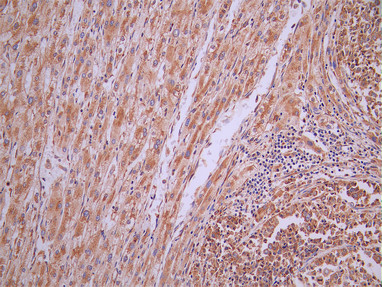
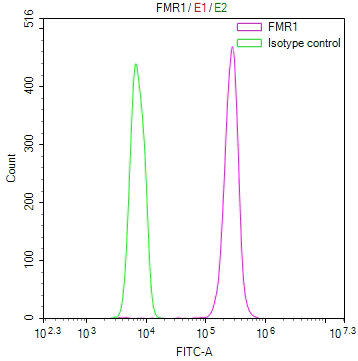
Validation studies demonstrate robust performance in multiple applications. Immunohistochemistry testing on paraffin-embedded human liver cancer tissue using a Leica Bond system with citrate buffer antigen retrieval shows clear specific staining at 1:100 dilution, confirming suitability for FFPE tissue analysis. Flow cytometry validation using HeLa cells reveals distinct positive signal separation from isotype control, with fixed and permeabilized cells showing reliable intracellular detection at 1:100 dilution. These validated protocols provide researchers with established starting points for their own experimental optimization.
For investigators studying FMR1 biology in contexts ranging from Fragile X syndrome pathophysiology to broader questions of translational regulation in neurons, this antibody delivers the technical reliability needed to generate meaningful, reproducible data across immunohistochemistry and flow cytometry workflows.
There are currently no reviews for this product.





