
Call us
301-363-4651 (Available 9 a.m. to 5 p.m. CST from Monday to Friday)

| Code | CSB-RA208150A0HU |
| Size | US$210 |
| Order now | |
| Image |
|
| Have Questions? | Leave a Message or Start an on-line Chat |
| Application | Recommended Dilution |
|---|---|
| IHC | 1:50-1:200 |
| IF | 1:50-1:200 |
| FC | 1:50-1:200 |
GTF2I, also known as General Transcription Factor II-I or TFII-I, serves as a multifunctional transcription factor with critical roles in signal-responsive gene regulation and chromatin remodeling. This protein acts as a key mediator connecting cell surface signaling events to nuclear transcriptional responses, functioning downstream of various growth factor and antigen receptor pathways. GTF2I has garnered significant research attention due to its association with Williams-Beuren syndrome, a neurodevelopmental disorder caused by hemizygous deletion of the chromosomal region containing this gene, making it an important target for studies investigating cognitive development and neurological function.
This recombinant monoclonal antibody, clone 13B10, offers researchers the reproducibility advantages inherent to recombinant technology. Because the antibody sequence is defined and produced from a stable expression system, you can expect consistent performance across experiments and over time, eliminating the lot-to-lot variability that can complicate long-term studies or multi-site collaborations.
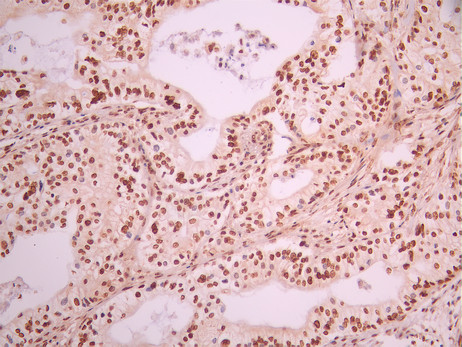
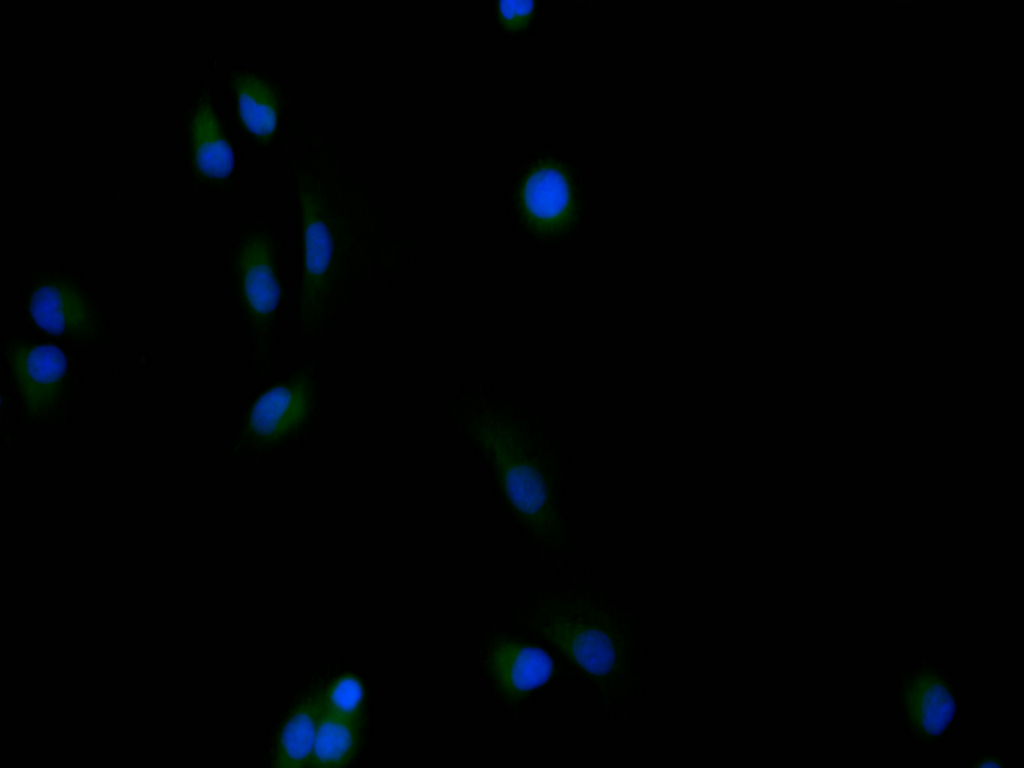
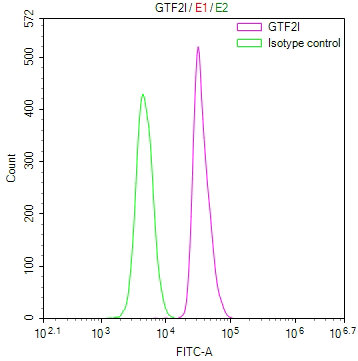
The antibody has been validated across multiple detection platforms, providing flexibility for diverse experimental workflows. Immunohistochemistry studies demonstrate clear nuclear staining in paraffin-embedded human pancreatic cancer tissue at dilutions of 1:50-1:200, with antigen retrieval performed using citrate buffer. Immunofluorescence analysis in A549 cells confirms nuclear localization patterns consistent with GTF2I's role as a transcription factor. Flow cytometry validation using SH-SY5Y neuroblastoma cells shows distinct positive population shifts compared to isotype controls, supporting applications in cell-based quantitative studies.
This antibody supports investigations into epigenetics and nuclear signaling pathways, particularly research exploring transcriptional regulation, signal transduction mechanisms, and neurodevelopmental biology where GTF2I function is implicated.
There are currently no reviews for this product.





