
Call us
301-363-4651 (Available 9 a.m. to 5 p.m. CST from Monday to Friday)

| Code | CSB-RA829498A0HU |
| Size | US$210 |
| Order now | |
| Image |
|
| Have Questions? | Leave a Message or Start an on-line Chat |
| Application | Recommended Dilution |
|---|---|
| WB | 1:500-1:2000 |
| FC | 1:50-1:200 |
HLA-A and HLA-B are major histocompatibility complex class I molecules that play a central role in adaptive immunity by presenting intracellular peptides to cytotoxic T lymphocytes. These highly polymorphic cell surface glycoproteins are essential for immune surveillance, enabling the recognition and elimination of virus-infected or transformed cells. Their expression patterns and functional status are critical considerations in transplantation immunology, tumor immunology, and infectious disease research, making reliable detection tools indispensable for investigators working across these fields.
This recombinant monoclonal antibody, generated against a synthetic peptide derived from human HLA-A and HLA-B, offers the reproducibility and consistency that demanding experimental workflows require. As a sequence-defined recombinant clone, it eliminates the lot-to-lot variability inherent in traditional hybridoma-derived antibodies, ensuring that your results remain comparable across extended studies and collaborative projects. The rabbit IgG format provides excellent signal-to-noise characteristics while maintaining compatibility with standard secondary detection systems.
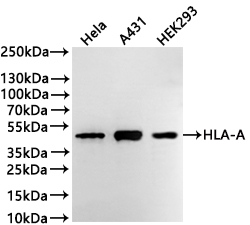
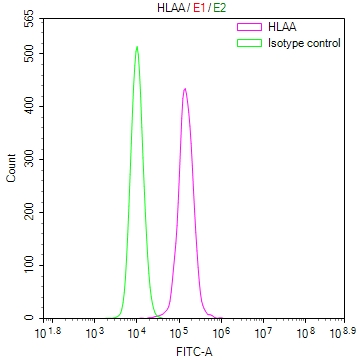
Validation studies demonstrate robust performance across multiple applications. In western blot analysis, the antibody detects a band at the predicted molecular weight of 41 kDa in HeLa, A431, and HEK293 whole cell lysates, confirming specificity for the target protein in diverse human cell line backgrounds. Flow cytometry validation using Raji cells shows clear positive staining with appropriate signal separation from isotype controls, supporting intracellular detection protocols following fixation and permeabilization.
This antibody serves researchers investigating antigen presentation pathways, immune checkpoint mechanisms, and MHC class I expression in cancer immunology contexts. Its validated performance in both biochemical and cell-based assays provides flexibility for studies examining HLA expression, regulation, and function in human experimental systems.
There are currently no reviews for this product.





