
Call us
301-363-4651 (Available 9 a.m. to 5 p.m. CST from Monday to Friday)

| Code | CSB-RA010833A0HU |
| Size | US$210 |
| Order now | |
| Image |
|
| Have Questions? | Leave a Message or Start an on-line Chat |
| Application | Recommended Dilution |
|---|---|
| WB | 1:500-1:5000 |
| IHC | 1:50-1:200 |
| IF | 1:20-1:200 |
| IP | 1:200-1:1000 |
HSPB1, commonly known as HSP27, is a small heat shock protein that plays a central role in cellular stress responses, protein folding, and apoptosis regulation. As a molecular chaperone, HSPB1 helps protect cells from thermal stress, oxidative damage, and other environmental insults, making it a critical target for researchers investigating signal transduction pathways, cancer biology, and cellular stress mechanisms.
This recombinant monoclonal antibody, clone 10C11, offers the reproducibility and consistency that demanding experimental workflows require. Because the antibody sequence is defined and produced recombinantly in rabbit host cells, you can expect reliable performance across experiments and between lots, eliminating the variability often encountered with traditional hybridoma-derived antibodies. The affinity-purified IgG format ensures high specificity for your target.
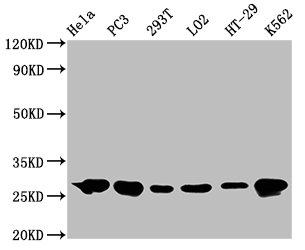
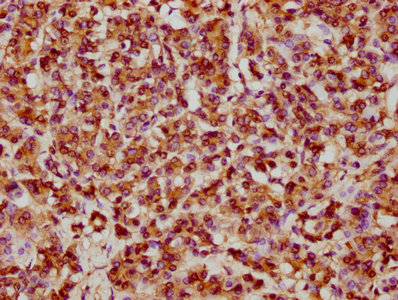
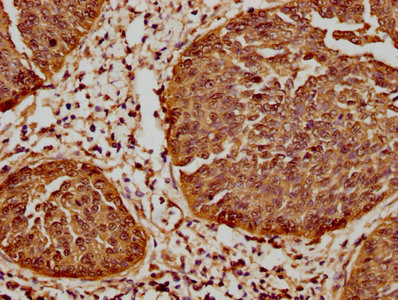
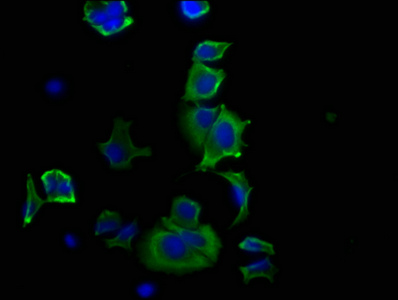
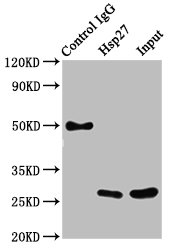
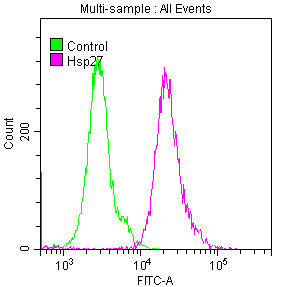
Extensive validation demonstrates this antibody's versatility across multiple applications. Western blot analysis confirms robust detection in a broad panel of human cell lines including HeLa, PC3, 293T, LO2, HT-29, and K562, with the observed band appearing at approximately 27 kDa rather than the predicted 23 kDa, a difference attributable to post-translational modifications such as phosphorylation that are characteristic of this stress-responsive protein. Immunohistochemistry validation in paraffin-embedded human pancreatic tissue and cervical cancer specimens confirms suitability for tissue-based studies. Additional validated applications include immunofluorescence staining in MCF-7 cells, immunoprecipitation from HeLa lysates, and flow cytometry analysis, providing flexibility for diverse experimental approaches.
Whether you are examining stress response pathways, investigating HSPB1's role in disease progression, or studying its chaperone functions, this antibody delivers the performance and consistency needed for reliable, publication-quality results.
There are currently no reviews for this product.





