
Call us
301-363-4651 (Available 9 a.m. to 5 p.m. CST from Monday to Friday)

| Code | CSB-RA097685A0HU |
| Size | US$210 |
| Order now | |
| Image |
|
| Have Questions? | Leave a Message or Start an on-line Chat |
| Application | Recommended Dilution |
|---|---|
| WB | 1:500-1:5000 |
| IHC | 1:50-1:200 |
ICAM3, also known as CD50, plays a critical role in leukocyte adhesion and immune cell communication. As a member of the intercellular adhesion molecule family, ICAM3 facilitates the initial contact between T cells and antigen-presenting cells, making it an important target for researchers investigating immune signaling, inflammatory responses, and lymphocyte activation pathways.
This recombinant monoclonal antibody, clone 5D1, offers the consistency and reliability that demanding experimental workflows require. Produced using recombinant technology with a defined sequence, this antibody eliminates the lot-to-lot variability often encountered with traditional hybridoma-derived reagents, ensuring reproducible results across extended studies. The rabbit IgG format, purified by affinity chromatography, delivers high specificity for human ICAM3.
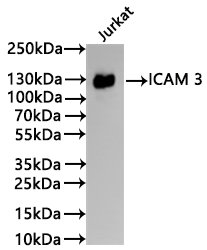
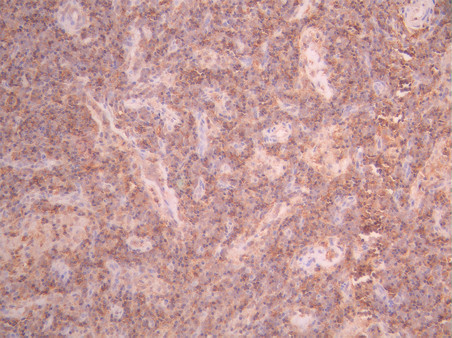
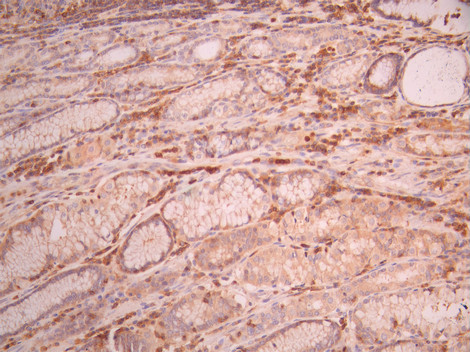
Validation studies demonstrate robust performance across multiple applications. In western blot analysis of Jurkat whole cell lysate, the antibody detects ICAM3 at an observed molecular weight of approximately 130 kDa, which is notably higher than the predicted 60 kDa. This size difference reflects the extensive glycosylation characteristic of ICAM3, a transmembrane glycoprotein known to carry multiple N-linked glycan modifications that significantly increase its apparent molecular weight. Immunohistochemistry validation confirms clear staining in paraffin-embedded human lymph node tissue and human gastric cancer tissue, with optimal results achieved at 1:100 dilution using citrate buffer antigen retrieval.
The flexibility to work across ELISA, western blot, and immunohistochemistry applications makes this antibody a versatile tool for signal transduction research. Whether examining ICAM3 expression in immune cell populations or investigating its role in pathological contexts, this antibody provides the performance characteristics needed for meaningful experimental outcomes.
There are currently no reviews for this product.





