
Call us
301-363-4651 (Available 9 a.m. to 5 p.m. CST from Monday to Friday)

| Code | CSB-RA062698A0HU |
| Size | US$210 |
| Order now | |
| Image |
|
| Have Questions? | Leave a Message or Start an on-line Chat |
| Application | Recommended Dilution |
|---|---|
| FC | 1:50-1:200 |
MCM5 serves as an essential component of the minichromosome maintenance complex, functioning as a DNA replication licensing factor that ensures accurate genome duplication occurs only once per cell cycle. This protein plays a critical role in the initiation of DNA replication and is frequently studied in the context of cell proliferation, cancer biology, and cell cycle regulation research.
This recombinant monoclonal antibody, clone 17B7, offers researchers the reproducibility advantages inherent to recombinant technology. Because the antibody sequence is defined and produced through controlled expression systems, you can expect consistent performance across different lots, eliminating the variability concerns that can complicate long-term studies or multi-site collaborations. The rabbit host origin combined with affinity chromatography purification yields a highly specific reagent suitable for demanding experimental workflows.
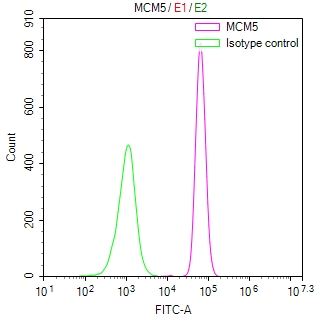
Validation studies demonstrate robust performance in flow cytometry applications using human Raji cells. In these experiments, cells were fixed with formaldehyde and permeabilized with Triton X-100, followed by blocking with normal goat serum. The antibody produced clear positive signal separation from isotype control, with recommended working dilutions ranging from 1:50 to 1:200 for flow cytometry applications. The antibody has also been validated for ELISA, providing flexibility for researchers who need to assess MCM5 levels across different experimental platforms.
The unconjugated format allows you to pair this antibody with your preferred secondary detection system, accommodating various fluorophore or enzyme conjugates depending on your instrumentation and multiplexing requirements. This MCM5 antibody is particularly well-suited for investigations into DNA replication dynamics, cell cycle checkpoint mechanisms, and proliferative states in cancer research models.
There are currently no reviews for this product.





