
Call us
301-363-4651 (Available 9 a.m. to 5 p.m. CST from Monday to Friday)

| Code | CSB-RA219742A0HU |
| Size | US$210 |
| Order now | |
| Image |
|
| Have Questions? | Leave a Message or Start an on-line Chat |
| Application | Recommended Dilution |
|---|---|
| IHC | 1:50-1:200 |
| FC | 1:50-1:200 |
NDUFAF1 serves as a critical assembly factor for mitochondrial Complex I, the largest enzyme of the respiratory chain. This protein facilitates the proper assembly of NADH:ubiquinone oxidoreductase, making it essential for cellular energy metabolism. Researchers investigating mitochondrial disorders, bioenergetics, and Complex I deficiencies will find NDUFAF1 a valuable target for understanding assembly pathway dynamics and disease mechanisms.
This recombinant monoclonal antibody, generated from clone 2D4 in rabbit host, offers the consistency and reproducibility that demanding experimental workflows require. Because recombinant production ensures sequence-defined specificity and eliminates the lot-to-lot variability inherent in traditional hybridoma methods, you can confidently compare results across extended studies and collaborative projects.
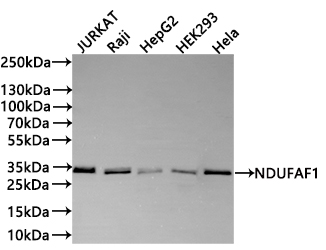
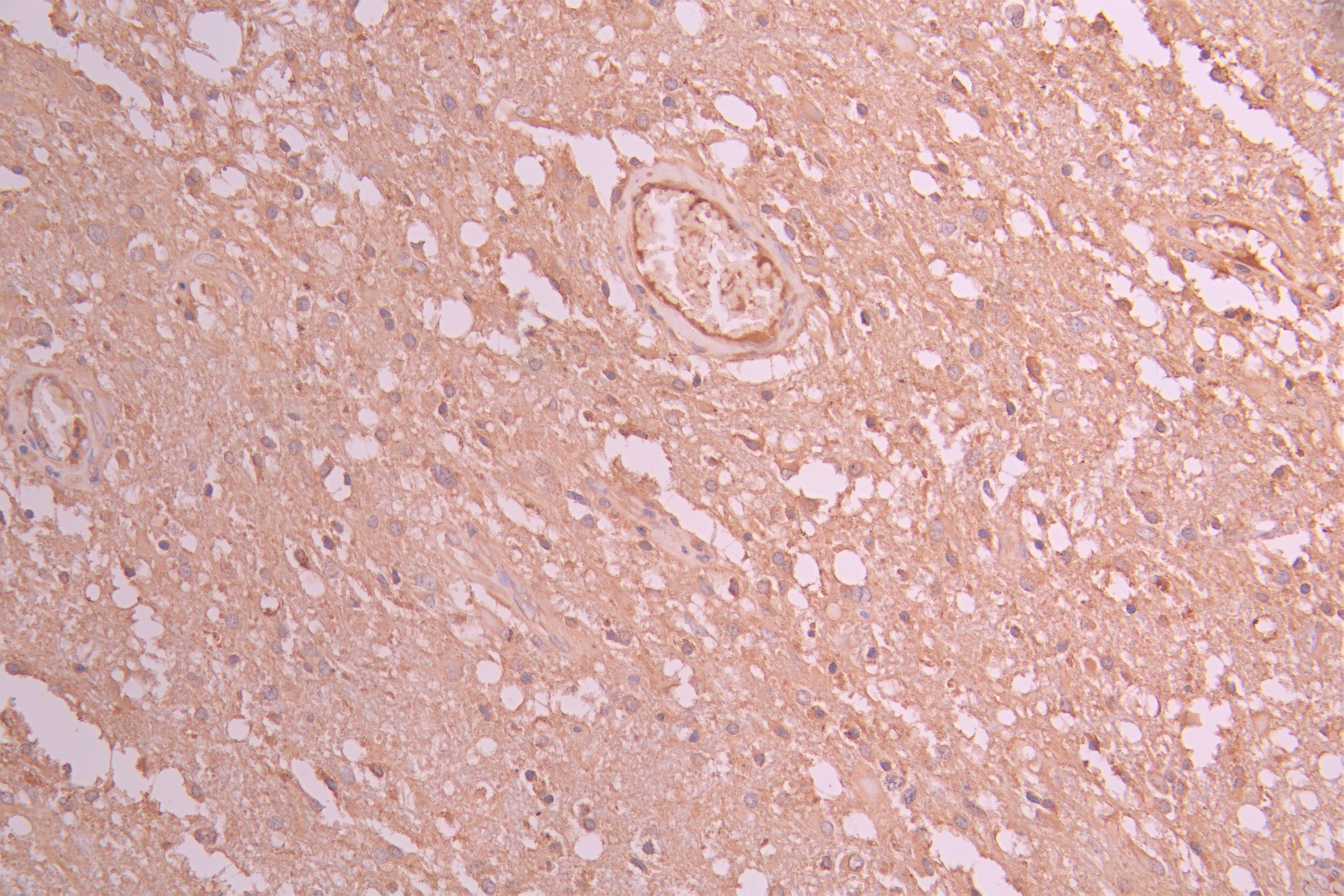
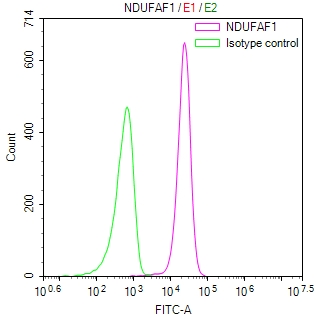
Validation testing demonstrates robust performance across multiple platforms. Western blot analysis detects NDUFAF1 in diverse human cell lines including Jurkat, Raji, HepG2, HEK293, and HeLa whole cell lysates, with an observed band at approximately 33 kDa. The observed 33 kDa Western Blot band (smaller than the predicted 38 kDa) reflects the antibody recognizing the actual expressed mature/alternatively spliced NDUFAF1 isoform (with reduced mass from mitochondrial targeting sequence removal or splicing), whereas 38 kDa represents the theoretical full-length/precursor size. Immunohistochemistry staining has been validated in paraffin-embedded human glioma tissue at dilutions of 1:50-1:200, providing clear visualization of target expression in disease-relevant samples. Flow cytometry applications have been confirmed using Jurkat cells, enabling quantitative analysis of NDUFAF1 expression at the single-cell level.
The unconjugated format allows flexibility in secondary antibody selection to match your detection system. This antibody supports research into mitochondrial assembly pathways, respiratory chain disorders, and cancer metabolism where Complex I dysfunction plays an increasingly recognized role.
There are currently no reviews for this product.





