
Call us
301-363-4651 (Available 9 a.m. to 5 p.m. CST from Monday to Friday)

| Code | CSB-RA785472A0HU |
| Size | US$210 |
| Order now | |
| Image |
|
| Have Questions? | Leave a Message or Start an on-line Chat |
| Application | Recommended Dilution |
|---|---|
| IHC | 1:50-1:200 |
| IF | 1:50-1:200 |
| FC | 1:50-1:200 |
OPA1 serves as a master regulator of mitochondrial dynamics, orchestrating inner membrane fusion events essential for maintaining cristae architecture and respiratory chain efficiency. This dynamin-related GTPase has emerged as a critical focus in research spanning neurodegeneration, metabolic disease, and cellular stress responses, with mutations linked to autosomal dominant optic atrophy and broader mitochondrial dysfunction syndromes.
This recombinant monoclonal antibody, clone 7D3, offers the reproducibility advantages inherent to sequence-defined production. Generated against a synthetic peptide from human OPA1, the antibody delivers consistent performance across experiments, eliminating the lot-to-lot variability that can complicate longitudinal studies of mitochondrial biology.
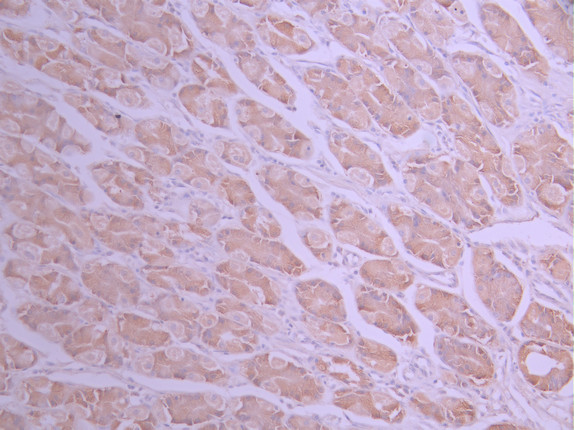
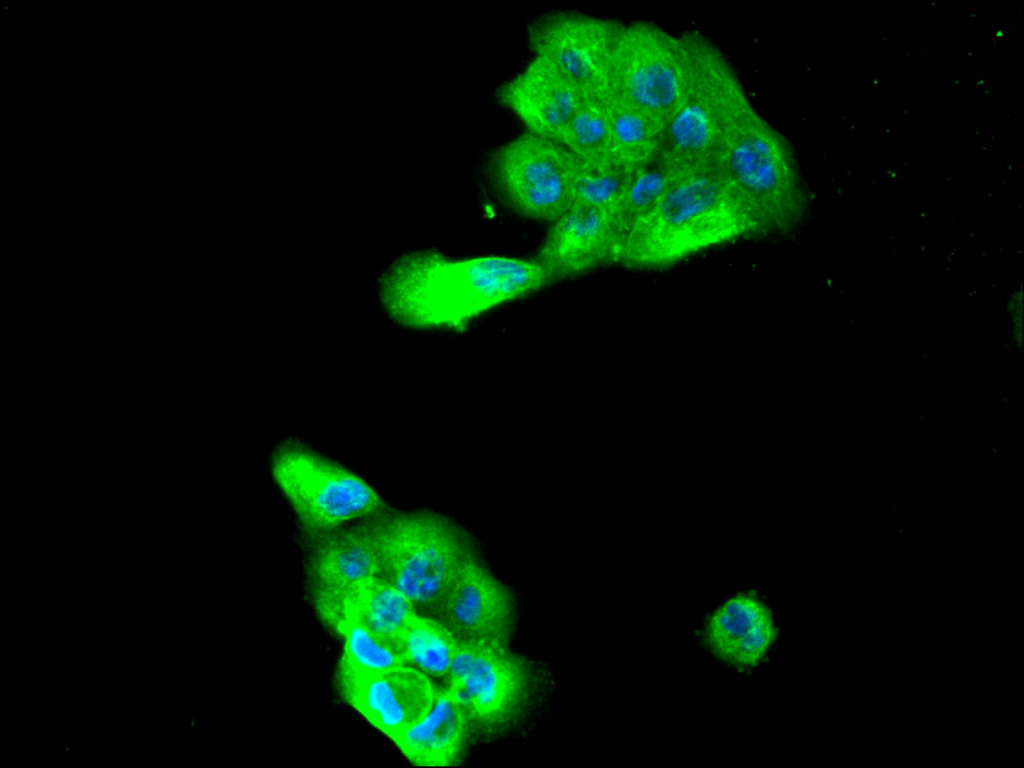
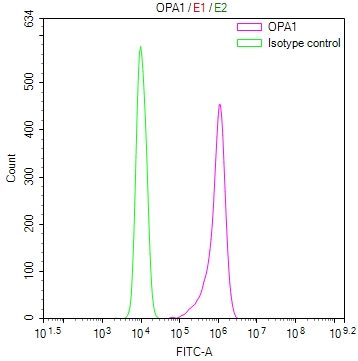
Validation across multiple detection platforms demonstrates genuine experimental flexibility. Immunohistochemistry testing in paraffin-embedded human stomach tissue at dilutions of 1:50–1:200 confirms reliable detection in archival specimens, while immunofluorescence studies in A431 epidermoid carcinoma cells reveal clear mitochondrial localization patterns when counterstained with DAPI. Flow cytometry analysis, also performed in A431 cells, shows distinct positive population shifts compared to isotype controls, enabling quantitative assessment of OPA1 expression levels in cell populations.
The antibody's performance across these complementary techniques supports diverse experimental designs, from tissue-based expression mapping to single-cell analysis of mitochondrial dynamics. Researchers investigating cristae remodeling, mitophagy pathways, or the intersection of mitochondrial fusion with apoptotic signaling will find this reagent well-suited to their workflows. Its validated compatibility with both fixed tissue sections and permeabilized cells provides options for correlating OPA1 expression patterns across different biological contexts and experimental systems.
There are currently no reviews for this product.





