
Call us
301-363-4651 (Available 9 a.m. to 5 p.m. CST from Monday to Friday)

| Code | CSB-RA996952A0HU |
| Size | US$210 |
| Order now | |
| Image |
|
| Have Questions? | Leave a Message or Start an on-line Chat |
| Application | Recommended Dilution |
|---|---|
| WB | 1:500-1:5000 |
Phosphodiesterase 4D plays a central role in regulating intracellular cAMP levels, making it a critical enzyme in signal transduction pathways that govern inflammation, cognition, and cardiovascular function. As a cAMP-specific phosphodiesterase, PDE4D hydrolyzes this essential second messenger, thereby modulating downstream signaling cascades involved in diverse physiological processes. Researchers investigating inflammatory diseases, neurological disorders, and metabolic regulation frequently target PDE4D to understand how cAMP dynamics influence cellular responses.
This recombinant monoclonal antibody, generated in rabbit against a synthetic peptide derived from human PDE4D, offers the consistency and reproducibility that demanding experimental workflows require. Because the antibody sequence is defined and production occurs through recombinant expression, you can expect minimal lot-to-lot variation compared to traditional hybridoma-derived antibodies. This reliability proves especially valuable for longitudinal studies or when standardizing protocols across research teams.
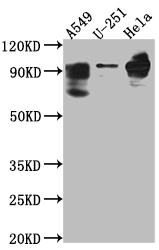
Validation in Western blot applications demonstrates robust detection in THP-1 whole cell lysates, a human monocytic cell line commonly used in immunology and inflammation research. At a 1:1000 dilution, the antibody detects a band at 92 kDa, consistent with one of the predicted molecular weights for PDE4D isoforms. The PDE4D gene encodes multiple splice variants with distinct molecular weights, and the observed 92 kDa band likely represents one of the larger isoforms expressed in this monocytic background. The recommended working dilution range of 1:500 to 1:5000 for Western blot provides flexibility for optimization across different sample types and detection systems.
This antibody serves researchers exploring signal transduction mechanisms, particularly those investigating cAMP-dependent pathways in human cellular models.
There are currently no reviews for this product.





