
Call us
301-363-4651 (Available 9 a.m. to 5 p.m. CST from Monday to Friday)

| Code | CSB-RA177398A0HU |
| Size | US$210 |
| Order now | |
| Image |
|
| Have Questions? | Leave a Message or Start an on-line Chat |
| Application | Recommended Dilution |
|---|---|
| WB | 1:500-1:5000 |
| IHC | 1:50-1:200 |
| FC | 1:50-1:200 |
PICALM (phosphatidylinositol-binding clathrin assembly protein) plays a central role in clathrin-mediated endocytosis, facilitating the internalization of membrane receptors and regulating intracellular trafficking. This protein has garnered significant attention in neuroscience research due to its genetic association with Alzheimer's disease risk, where variants in the PICALM locus have been consistently identified in genome-wide association studies. Understanding PICALM expression and function is therefore critical for researchers investigating endocytic pathways, synaptic vesicle recycling, and neurodegenerative disease mechanisms.
This recombinant monoclonal antibody, clone 7F10, offers the reproducibility and consistency that demanding experimental workflows require. Generated against a synthetic peptide from human PICALM and produced using recombinant technology, this antibody provides sequence-defined specificity with minimal lot-to-lot variation, ensuring your results remain comparable across extended studies.
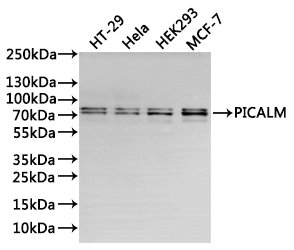
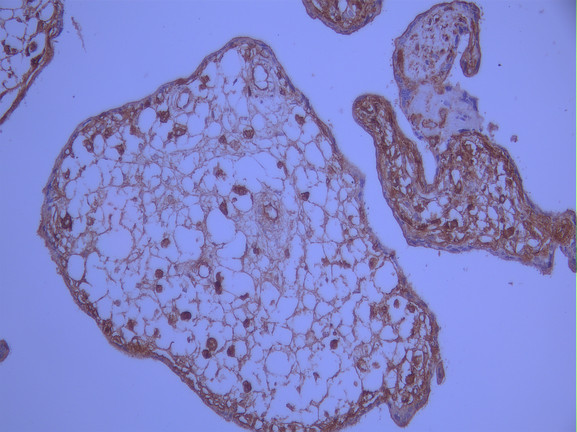
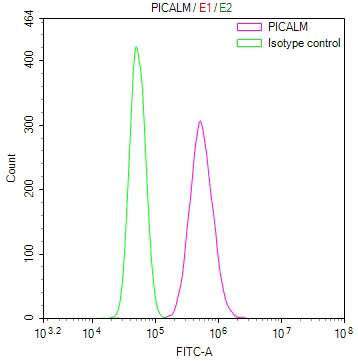
Validation across multiple applications demonstrates genuine experimental flexibility. Western blot analysis confirms robust detection in human cell lines including HT-29, HeLa, HEK293, and MCF-7, with observed bands at 69 and 71 kDa closely matching the predicted 71 kDa molecular weight. The slight size variation likely reflects post-translational modifications or alternative isoform expression. Immunohistochemistry has been validated in paraffin-embedded human placenta tissue using standard citrate buffer antigen retrieval, while flow cytometry analysis in 786-O cells demonstrates clear positive signal separation from isotype controls.
The antibody is supplied in a glycerol-containing buffer optimized for long-term storage stability. Whether you are characterizing PICALM expression patterns, investigating endocytic machinery, or exploring its role in neurological disease models, this antibody provides a reliable tool for your research.
There are currently no reviews for this product.





