PPP6C Recombinant Monoclonal Antibody

Code CSB-RA115186A0HU
Size US$210
Order now
Image
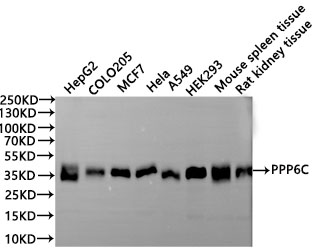
  • Western Blot
    Positive WB detected in: HepG2 whole cell lysate(30µg), COLO205 whole cell lysate(30µg), MCF7 whole cell lysate(30µg), Hela whole cell lysate(30µg), A549 whole cell lysate(30µg), HEK293 whole cell lysate(30µg), Mouse spleen tissue lysate(30µg), Rat kidney tissue lysate(30µg)
    All lanes: PPP6C antibody at 1:1000
    Secondary
    Goat polyclonal to rabbit IgG at 1/40000 dilution
    Predicted band size: 35 kDa
    Observed band size: 35 kDa
    Exposure time:30s
Have Questions? Leave a Message or Start an on-line Chat

Product Details

Uniprot No.
Target Names
Alternative Names
Serine/threonine-protein phosphatase 6 catalytic subunit (PP6C) (EC 3.1.3.16) [Cleaved into: Serine/threonine-protein phosphatase 6 catalytic subunit, N-terminally processed], PPP6C, PPP6
Species Reactivity
Human, Mouse, Rat
Immunogen
A synthesized peptide derived from Human PPP6C protein
Immunogen Species
Homo sapiens (Human)
Conjugate
Non-conjugated
Clonality
Monoclonal
Isotype
Rabbit IgG
Clone No.
4E3
Purification Method
Affinity-chromatography
Concentration
It differs from different batches. Please contact us to confirm it.
Buffer
Rabbit IgG in 10mM phosphate buffered saline , pH 7.4, 150mM sodium chloride, 0.05% BSA, 0.02% sodium azide and 50% glycerol.
Form
Liquid
Tested Applications
ELISA, WB
Recommended Dilution
Application Recommended Dilution
WB 1:500-1:5000
Troubleshooting and FAQs
Storage
Upon receipt, store at -20°C or -80°C. Avoid repeated freeze.
Lead Time
Basically, we can dispatch the products out in 1-3 working days after receiving your orders. Delivery time maybe differs from different purchasing way or location, please kindly consult your local distributors for specific delivery time.
Usage
For Research Use Only. Not for use in diagnostic or therapeutic procedures.
Customer Reviews and Q&A

 Customer Reviews

There are currently no reviews for this product.

Submit a Review here

Target Background

Function
Catalytic subunit of protein phosphatase 6 (PP6). PP6 is a component of a signaling pathway regulating cell cycle progression in response to IL2 receptor stimulation. N-terminal domain restricts G1 to S phase progression in cancer cells, in part through control of cyclin D1. During mitosis, regulates spindle positioning. Downregulates MAP3K7 kinase activation of the IL1 signaling pathway by dephosphorylation of MAP3K7. Participates also in the innate immune defense against viruses by desphosphorylating RIG-I/DDX58, an essential step that triggers RIG-I/DDX58-mediated signaling activation.
Gene References into Functions
  1. PP6 rapidly interacts with ASK3 in an osmolality-dependent manner, and it inactivates ASK3 to induce RVI and, thereby, cell survival under hyperosmotic stress. PMID: 29539411
  2. findings define the WHIP-TRIM14-PPP6C mitochondrial signalosome required for RIG-I-mediated innate antiviral immunity. PMID: 29053956
  3. findings suggest that BRCA1 is a novel modulator of PP6 signalling via its interaction with ANKRD28. PMID: 27026398
  4. Data show 408 phosphopeptides on 272 proteins that increased and 298 phosphopeptides on 220 proteins that decreased in phosphorylation upon catalytic subunit of rotein phosphatase 6 (PP6c) depletion in mitotic cells. PMID: 26462736
  5. Protein phosphatase 6 (ppp6c), a negative regulator that restricts the G1 to S phase progression, is diminished in human psoriatic epidermis and is directly targeted by miR-31. PMID: 26138368
  6. PP6 is involved in a diverse set of biological pathways. PMID: 25999147
  7. These results suggest that human PP6 interacts with and positively regulates the activity of the influenza A virus RNA-dependent RNA polymerase. PMID: 25187537
  8. PP6C mutations have distinct functional and clinical consequences in melanoma, and confer sensitivity to Aurora A kinase inhibitors. PMID: 24336958
  9. PP6c associates with E-cadherin in adherens junctions and is required to oppose casein kinase-1 to maintain cell surface localization of E-cadherin. PMID: 24063632
  10. Findings support the view that formation of micronuclei rather than chromosome instability alone explains how loss of PPP6C, and more generally mitotic spindle and centrosome defects, can act as drivers for genome instability in melanoma. PMID: 23729733
  11. Results show that Sit4p and its mammalian orthologue, PP6, regulate traffic from the ER to the Golgi complex which is consistent with its role in coat recycling. PMID: 23864707
  12. miR-373 can regulate cell cycle progression by targeting PPP6C transcripts and promotes the growth activity of HCC cells in vitro. The downregulation of PPP6C by miR-373 may explain why the expression of miR-373 can promote HCC cell proliferation. PMID: 21481188
  13. PP6 is required for non-homologous end joining repair; its expression may harbor a protective role during the development of breast cancer tissues. PMID: 21451261
  14. Results demonstrate a role for PP6 as the T-loop phosphatase regulating Aurora A activity bound to its activator TPX2 during mitotic spindle formation. PMID: 21187329
  15. A novel function of DNA-PKcs is to recruit PP6 to sites of DNA damage and that PP6 contributes to the dephosphorylation of gamma-H2AX, the dissolution of ionizing radiation-induced foci, and release from the G(2)/M checkpoint in vivo. PMID: 20065038
  16. Protein phosphatase 6 subunit with conserved Sit4-associated protein domain targets IkappaBepsilon PMID: 16769727
  17. PP6 regulates cell cycle progression in human cells at least in part through control of cyclin D1 and the function of PP6 is distinct from its homolog Sit4 in yeast. PMID: 17568194
  18. Our data demonstrate that protein phosphatase-6 associates with and activates DNA-PK in response to ionizing radiation. PMID: 19198648
  19. results illustrate that the human PP6-associated proteins are capable of providing distinct rapamycin-sensitive and Sit4-dependent Sap functions in the heterologous context of the yeast cell PMID: 19621075
  20. our results seem to discard the role of the previously described polymorphisms in SERPINE2, PPP6C and PBX3 in celiac disease susceptibility. PMID: 19626039

Show More

Hide All

Subcellular Location
Mitochondrion. Cytoplasm.
Protein Families
PPP phosphatase family, PP-6 (PP-V) subfamily
Tissue Specificity
Ubiquitously expressed in all tissues tested with highest expression levels in testis, heart, kidney, brain, stomach, liver and skeletal muscle and lowest in placenta, lung colon and spleen.
Database Links

HGNC: 9323

OMIM: 612725

KEGG: hsa:5537

UniGene: Hs.744091

icon of phone
Call us
301-363-4651 (Available 9 a.m. to 5 p.m. CST from Monday to Friday)
icon of address
Address
7505 Fannin St., Ste 610, Room 7 (CUBIO Innovation Center), Houston, TX 77054, USA
icon of social media
Join us with

Subscribe newsletter

Leave a message

* To protect against spam, please pass the CAPTCHA test below.
CAPTCHA verification
© 2007-2026 CUSABIO TECHNOLOGY LLC All rights reserved. 鄂ICP备15011166号-1
Place an order now

I. Product details

*
*
*
*

II. Contact details

*
*

III. Ship To

*
*
*
*
*
*
*

IV. Bill To

*
*
*
*
*
*
*
*



