
Call us
301-363-4651 (Available 9 a.m. to 5 p.m. CST from Monday to Friday)

| Code | CSB-RA176962A0HU |
| Size | US$210 |
| Order now | |
| Image |
|
| Have Questions? | Leave a Message or Start an on-line Chat |
| Application | Recommended Dilution |
|---|---|
| WB | 1:500-1:5000 |
| IHC | 1:50-1:200 |
PRMT5 (protein arginine N-methyltransferase 5) serves as a critical epigenetic regulator that catalyzes the symmetric dimethylation of arginine residues on histones and non-histone substrates. This enzymatic activity influences diverse cellular processes including transcriptional regulation, RNA splicing, and cell cycle progression, making PRMT5 a compelling target in cancer biology and epigenetic research. Dysregulation of PRMT5 has been implicated in multiple malignancies, positioning it as both a biomarker of interest and a potential therapeutic target.
This recombinant monoclonal antibody, generated against a synthetic peptide derived from human PRMT5, offers the reproducibility and sequence-defined consistency that demanding experimental workflows require. As a recombinant clone produced in rabbit, it eliminates the lot-to-lot variability that can compromise longitudinal studies or multi-site collaborations, ensuring your results remain comparable across experiments.
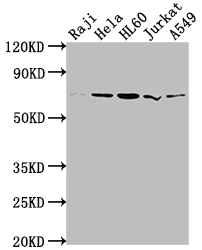
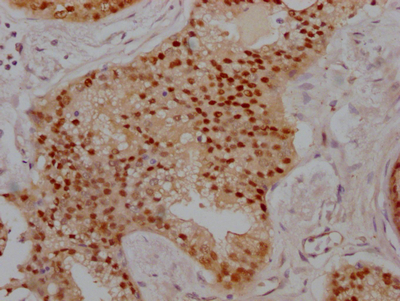
Validation studies demonstrate robust performance across multiple applications. In western blot analysis, the antibody detects a band at the expected 73 kDa molecular weight across a diverse panel of human cell lines including Raji, HeLa, HL60, Jurkat, and A549, confirming reliable detection in both hematological and solid tumor models. The antibody performs effectively at dilutions ranging from 1:500 to 1:5000 for western blotting. Immunohistochemistry validation in paraffin-embedded human prostate cancer tissue at 1:100 dilution reveals clear staining following citrate buffer antigen retrieval, demonstrating suitability for archival tissue analysis.
Whether investigating PRMT5's role in chromatin remodeling, exploring its function in oncogenic signaling pathways, or characterizing expression patterns in disease tissues, this antibody provides a dependable tool for epigenetics and nuclear signaling research.
There are currently no reviews for this product.





