
Call us
301-363-4651 (Available 9 a.m. to 5 p.m. CST from Monday to Friday)

| Code | CSB-RA879024A0HU |
| Size | US$210 |
| Order now | |
| Image |
|
| Have Questions? | Leave a Message or Start an on-line Chat |
| Application | Recommended Dilution |
|---|---|
| WB | 1:500-1:2000 |
| IF | 1:50-1:200 |
| FC | 1:50-1:200 |
PSMC5, also known as RPT6 or SUG1, is an essential AAA-ATPase subunit of the 26S proteasome regulatory particle. This protein plays a critical role in ATP-dependent protein degradation through the ubiquitin-proteasome system, making it central to cellular processes including cell cycle regulation, signal transduction, and protein quality control. Beyond its proteasomal function, PSMC5 has been identified as a thyroid hormone receptor-interacting protein (TRIP1), suggesting additional roles in transcriptional regulation that continue to attract research interest.
This recombinant rabbit monoclonal antibody, clone 4E5, offers the reproducibility and consistency that demanding proteasome research requires. Developed against a synthetic peptide derived from human PSMC5, the recombinant production method ensures sequence-defined specificity and eliminates the lot-to-lot variability that can complicate long-term studies or multi-site collaborations.
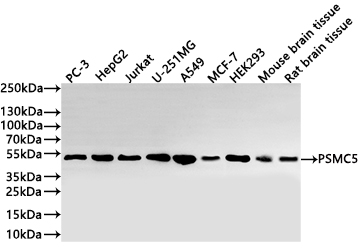
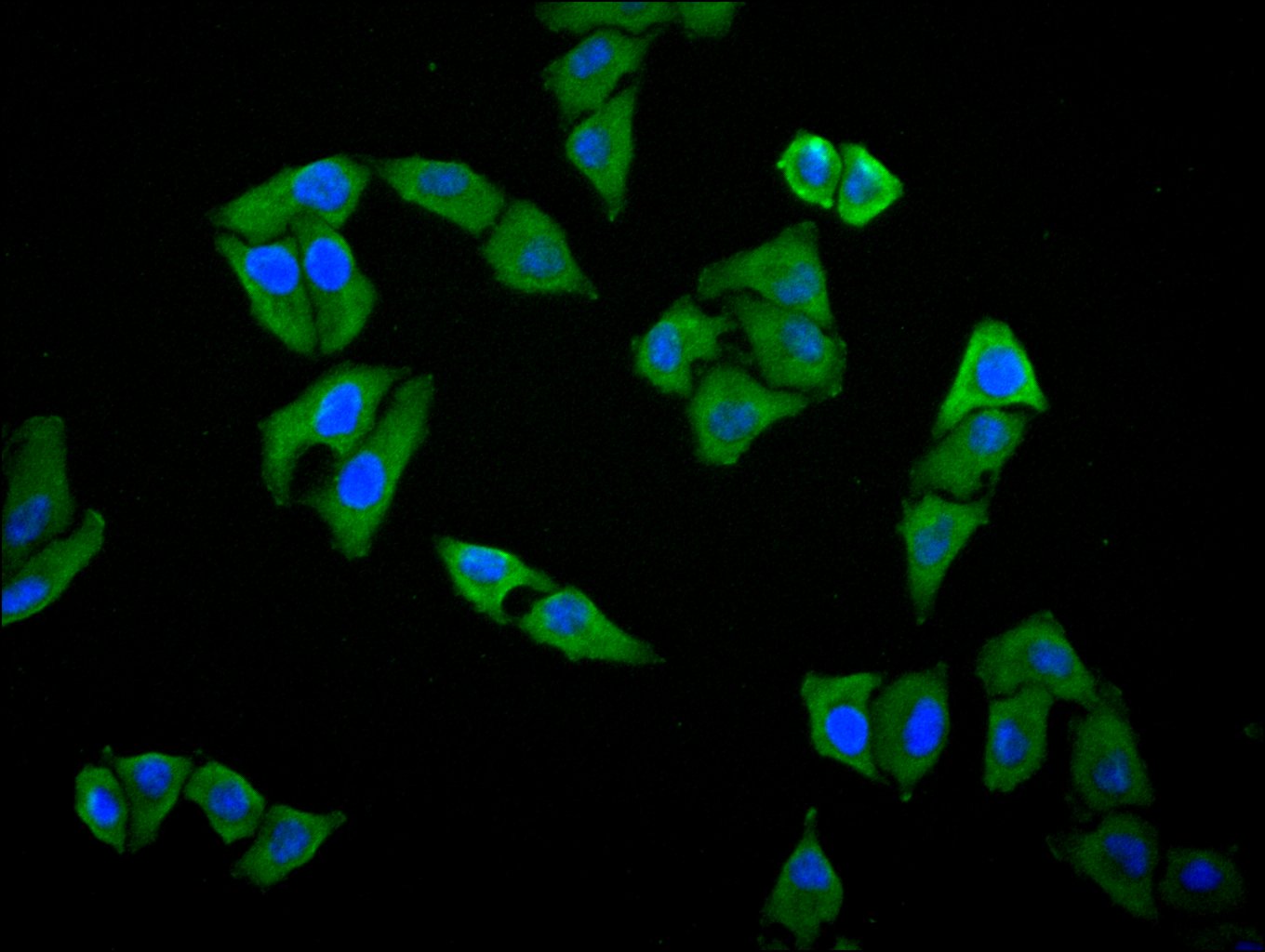
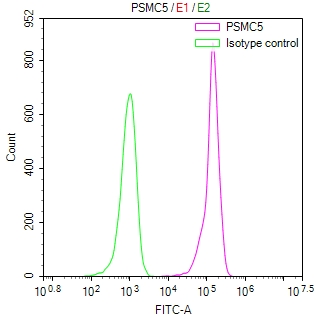
Validation data demonstrates robust performance across multiple experimental platforms. In western blot applications, the antibody detects PSMC5 in a diverse panel of human cell lines including PC-3, HepG2, Jurkat, U-251MG, A549, MCF-7, and HEK293, as well as mouse and rat brain tissue lysates, confirming reliable cross-species reactivity. The observed band at approximately 50 kDa, slightly higher than the predicted 46 kDa molecular weight, likely reflects post-translational modifications characteristic of this protein. Immunofluorescence studies in HeLa cells reveal clear cytoplasmic and nuclear localization patterns, while flow cytometry validation in SH-SY5Y neuroblastoma cells demonstrates suitability for quantitative single-cell analysis.
This antibody serves researchers investigating proteasome biology, protein homeostasis, neurodegenerative disease mechanisms, and hormone receptor signaling pathways where PSMC5 function is implicated.
There are currently no reviews for this product.





