
Call us
301-363-4651 (Available 9 a.m. to 5 p.m. CST from Monday to Friday)

| Code | CSB-RA010791A326phHU |
| Size | US$210 |
| Order now | |
| Image |
|
| Have Questions? | Leave a Message or Start an on-line Chat |
| Application | Recommended Dilution |
|---|---|
| WB | 1:500-1:5000 |
| IHC | 1:50-1:200 |
Heat shock factor 1 serves as the master transcriptional regulator of the cellular heat shock response, orchestrating the expression of molecular chaperones and stress-protective proteins when cells encounter proteotoxic conditions. Phosphorylation at serine 326 represents a critical activating modification that enhances HSF1 transcriptional competence, making this specific phospho-epitope particularly valuable for researchers investigating stress signaling pathways, protein homeostasis networks, and the increasingly recognized roles of HSF1 in cancer biology and neurodegeneration.
This recombinant monoclonal antibody, generated from clone 2A7 in rabbit host, offers the reproducibility advantages inherent to sequence-defined recombinant production. Unlike traditional hybridoma-derived antibodies, each lot delivers consistent performance characteristics, eliminating the variability that can complicate longitudinal studies or multi-site collaborations. The antibody was raised against a synthetic phosphopeptide corresponding to the human phospho-HSF1 S326 region, ensuring precise epitope targeting for this functionally significant modification.
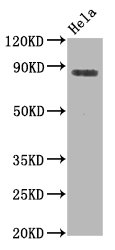
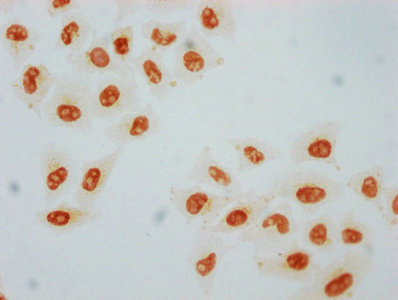
Validation studies demonstrate reliable performance across multiple experimental platforms. Western blot analysis in HeLa whole cell lysates reveals a clean band at the predicted 82 kDa molecular weight, confirming accurate target recognition with recommended dilutions ranging from 1:500 to 1:5000. Immunohistochemistry applications have been validated in HeLa cells using formaldehyde fixation and Triton X-100 permeabilization, with effective staining observed at 1:50 to 1:200 dilutions. The antibody is also suitable for ELISA-based quantification approaches.
For researchers exploring stress response mechanisms, proteostasis regulation, or the emerging connections between HSF1 activation and disease pathology, this phospho-specific antibody provides a dependable tool for detecting and quantifying this key regulatory modification in human samples.
There are currently no reviews for this product.





