
Call us
301-363-4651 (Available 9 a.m. to 5 p.m. CST from Monday to Friday)

| Code | CSB-RA018714A2056phHU |
| Size | US$210 |
| Order now | |
| Image |
|
| Have Questions? | Leave a Message or Start an on-line Chat |
| Application | Recommended Dilution |
|---|---|
| IF | 1:20-1:200 |
DNA-dependent protein kinase catalytic subunit (DNA-PKcs, encoded by PRKDC) serves as a central regulator of the non-homologous end joining pathway, the primary mechanism for repairing DNA double-strand breaks in mammalian cells. Phosphorylation at serine 2056 represents a critical autophosphorylation event that occurs in response to DNA damage, making this modification an essential marker for studying DNA damage response activation and repair pathway dynamics.
This recombinant monoclonal antibody, generated from clone 4A4, specifically recognizes the phosphorylated S2056 epitope on human DNA-PKcs. The recombinant production platform ensures consistent performance across experiments, with each lot derived from a defined antibody sequence. This eliminates the batch variability that can complicate longitudinal studies or multi-site collaborations investigating DNA damage signaling.
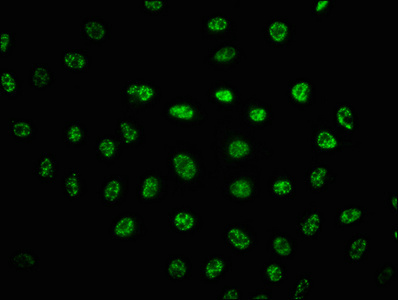
Validation through immunofluorescence demonstrates clear detection of phospho-PRKDC in UV-treated HeLa cells, confirming the antibody's ability to recognize the damage-induced phosphorylation event in its native cellular context. The nuclear localization pattern observed aligns with the expected recruitment of activated DNA-PKcs to damage sites. For immunofluorescence applications, dilutions ranging from 1:20 to 1:200 provide flexibility for optimization across different experimental conditions and imaging systems.
Researchers investigating DNA repair mechanisms, checkpoint signaling, or cellular responses to genotoxic stress will find this antibody particularly valuable for monitoring DNA-PKcs activation status. The phospho-specific detection capability supports studies examining how cells respond to radiation, chemotherapeutic agents, or other DNA-damaging conditions, making it a useful tool for both basic research in epigenetics and nuclear signaling as well as translational studies exploring DNA damage response pathways.
There are currently no reviews for this product.





