
Call us
301-363-4651 (Available 9 a.m. to 5 p.m. CST from Monday to Friday)

| Code | CSB-RA244708A0HU |
| Size | US$210 |
| Order now | |
| Image |
|
| Have Questions? | Leave a Message or Start an on-line Chat |
| Application | Recommended Dilution |
|---|---|
| IF | 1:50-1:200 |
| FC | 1:50-1:200 |
RAD17 serves as a critical checkpoint protein in the DNA damage response pathway, functioning as a component of the RAD17-RFC complex that loads the 9-1-1 checkpoint clamp onto DNA at sites of damage. Phosphorylation at serine 656 represents a key regulatory event in checkpoint activation, making this modification an important marker for studying cellular responses to genotoxic stress and replication fork stalling.
This recombinant monoclonal antibody, clone 5F5, specifically recognizes phospho-RAD17 at the S656 residue in human samples. Developed using recombinant technology in rabbit host, this antibody offers the consistency and reproducibility that demanding checkpoint signaling studies require. Because the antibody sequence is defined and produced from a stable expression system, researchers can expect reliable performance across experiments and between lots, eliminating the variability that can complicate longitudinal studies of DNA damage signaling.
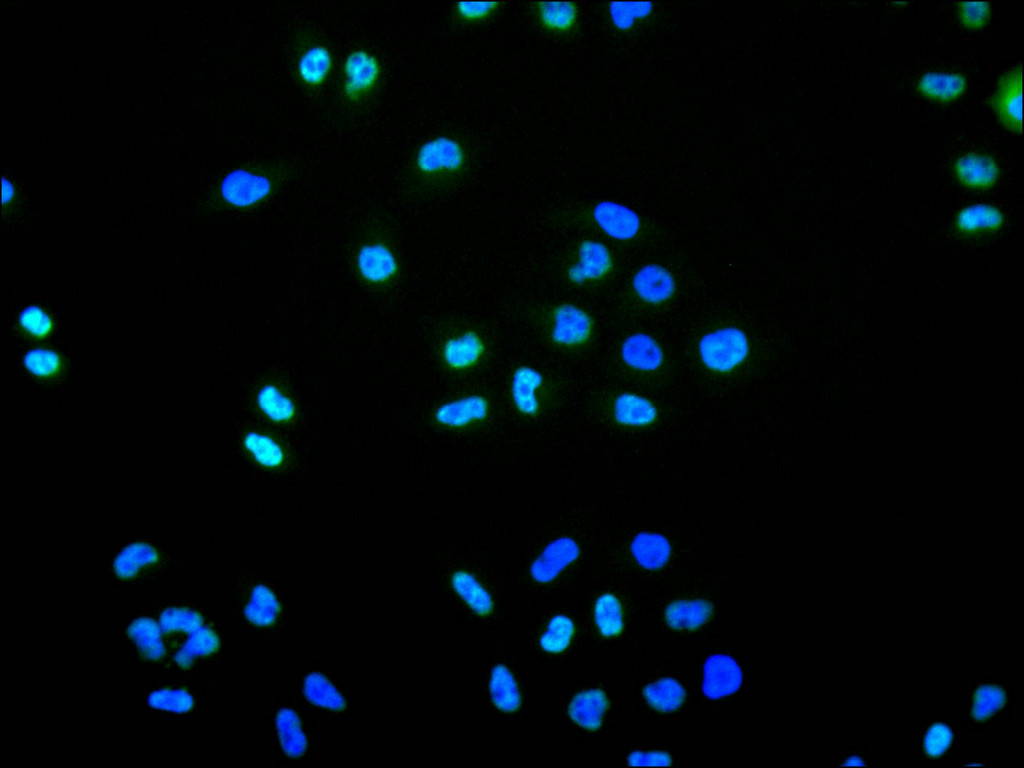
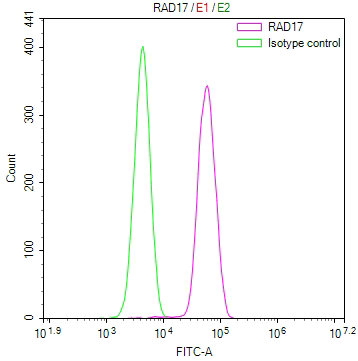
Validation studies demonstrate robust performance in immunofluorescence and flow cytometry applications. Immunofluorescence staining of HeLa cells at dilutions between 1:50 and 1:200 reveals clear signal with appropriate subcellular localization when counterstained with DAPI. Flow cytometric analysis of Jurkat cells confirms specific detection, with overlay histograms showing distinct separation between antibody-stained populations and isotype control, indicating reliable signal-to-noise characteristics suitable for quantitative analysis of phospho-RAD17 levels in cell populations.
The unconjugated format provides flexibility for researchers to pair this antibody with their preferred secondary detection systems across different experimental platforms. For investigators studying checkpoint signaling, DNA damage responses, or cell cycle regulation, this phospho-specific antibody offers a well-characterized tool for monitoring RAD17 activation status in human cell models.
There are currently no reviews for this product.





