
Call us
301-363-4651 (Available 9 a.m. to 5 p.m. CST from Monday to Friday)

| Code | CSB-RA280045A0HU |
| Size | US$210 |
| Order now | |
| Image |
|
| Have Questions? | Leave a Message or Start an on-line Chat |
| Application | Recommended Dilution |
|---|---|
| WB | 1:500-1:5000 |
| FC | 1:50-1:200 |
Syntaxin-3 plays a central role in membrane trafficking and vesicle fusion events, particularly in polarized epithelial cells where it facilitates the targeted delivery of proteins to the apical membrane. This SNARE protein is essential for maintaining cellular polarity and has garnered significant research interest for its involvement in secretory pathways, neurotransmitter release, and epithelial barrier function.
This recombinant monoclonal antibody against human STX3 offers the reproducibility and consistency that demanding experimental workflows require. Generated through recombinant technology with a defined sequence, it eliminates the lot-to-lot variability often encountered with traditional hybridoma-derived antibodies, ensuring your results remain comparable across extended studies and collaborative projects.
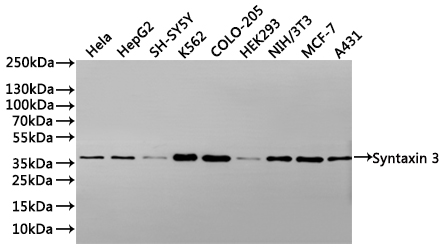
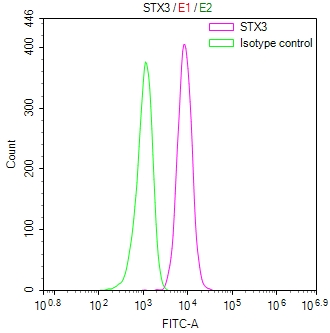
Validation testing demonstrates robust performance across multiple experimental platforms. Western blot analysis at 1:1000 dilution reveals specific detection of Syntaxin-3 across a diverse panel of human cell lines, including HeLa, HepG2, SH-SY5Y, K562, COLO-205, HEK293, MCF-7, and A431 cells. The observed band size of 36 kDa, slightly higher than the predicted 33 kDa molecular weight, likely attributes to the mobility deviation of STX3 in SDS-PAGE (influence of amino acid composition/conformation) or minor post-translational modifications (such as low-abundance glycosylation/phosphorylation). Flow cytometry applications have been validated using A431 cells with clear positive signal separation from isotype controls, with recommended dilutions ranging from 1:50 to 1:200.
Whether investigating epithelial polarity mechanisms, secretory pathway dynamics, or SNARE complex assembly, this antibody provides a reliable tool for researchers studying membrane trafficking biology. Its validated performance in both protein detection and single-cell analysis applications offers flexibility for comprehensive characterization of STX3 expression and localization in your experimental systems.
There are currently no reviews for this product.





