
Call us
301-363-4651 (Available 9 a.m. to 5 p.m. CST from Monday to Friday)

| Code | CSB-RA101412A0HU |
| Size | US$210 |
| Order now | |
| Image |
|
| Have Questions? | Leave a Message or Start an on-line Chat |
| Application | Recommended Dilution |
|---|---|
| IHC | 1:50-1:200 |
| IF | 1:50-1:200 |
| FC | 1:50-1:200 |
SUMO4 belongs to the small ubiquitin-like modifier family, a group of proteins that regulate cellular processes through post-translational conjugation to target substrates. Unlike other SUMO family members, SUMO4 expression is predominantly restricted to specific tissues and has garnered significant research interest due to its genetic association with type 1 diabetes susceptibility. The protein plays important roles in modulating immune responses and stress signaling pathways, making it a valuable target for investigators studying autoimmune disease mechanisms and cellular stress responses.
This recombinant monoclonal antibody, clone 19F12, offers the consistency and reproducibility that demanding experimental workflows require. Generated through recombinant technology with a defined sequence, this rabbit IgG eliminates the lot-to-lot variability inherent in traditional hybridoma-derived antibodies, ensuring your results remain comparable across extended studies. The antibody was raised against a synthetic peptide derived from human SUMO4 and purified by affinity chromatography for optimal specificity.
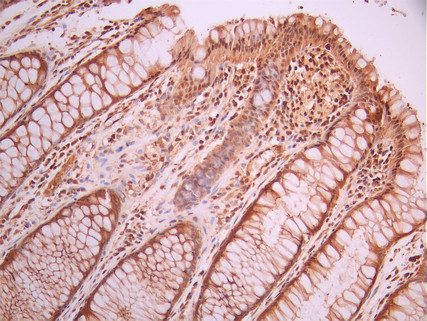
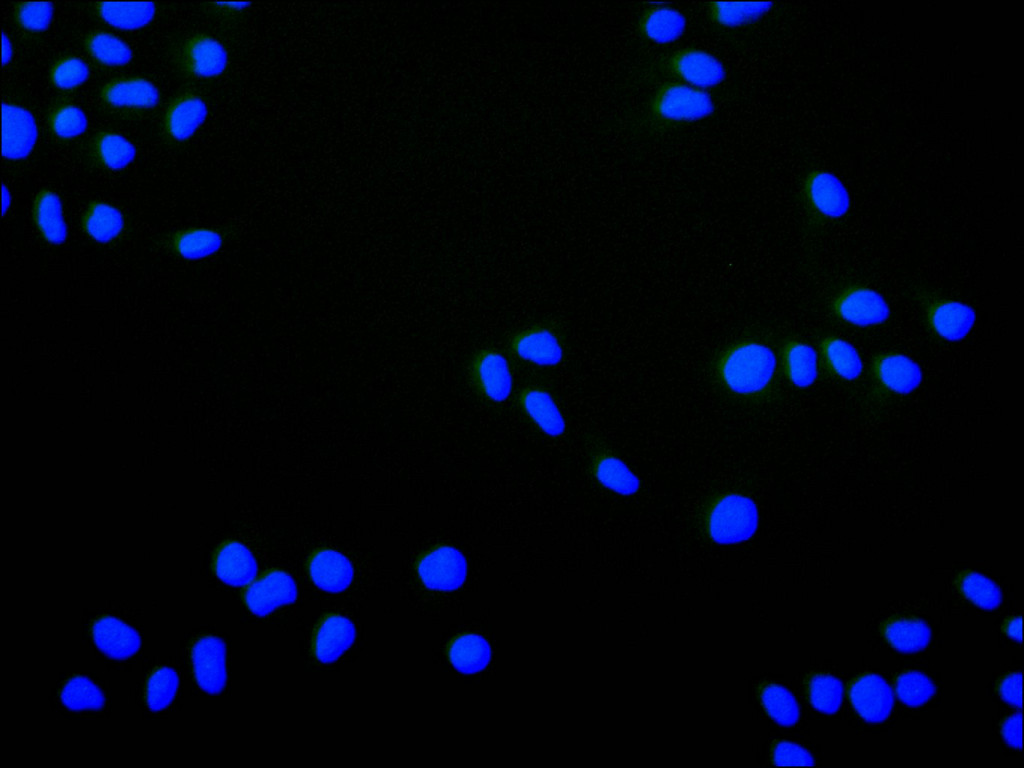
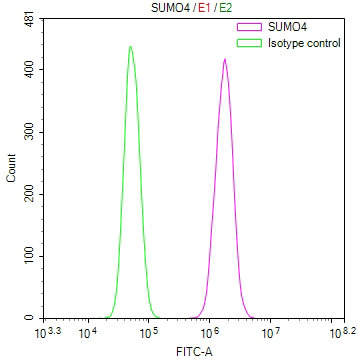
Validation across multiple detection platforms demonstrates this antibody's versatility in your research applications. Immunohistochemistry studies in paraffin-embedded human colorectal cancer tissue show clear staining at dilutions of 1:50–1:200, while immunofluorescence analysis in HeLa cells reveals distinct signal with DAPI counterstaining for subcellular localization studies. Flow cytometry validation using 786-O renal carcinoma cells confirms reliable detection of intracellular SUMO4 following fixation and permeabilization, with clear separation from isotype control.
Whether investigating SUMO4's role in immune regulation, exploring its connections to metabolic disease, or examining sumoylation dynamics in cancer biology, this antibody provides the technical foundation for robust, reproducible cell biology research.
There are currently no reviews for this product.





