SUPT5H Recombinant Monoclonal Antibody

Code CSB-RA269987A0HU
Size US$210
Order now
Image
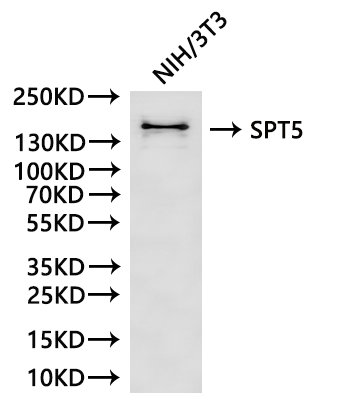
  • Western Blot
    , Positive WB detected in:NIH/3T3 whole cell lysate(30µg)
    All lanes: SPT5 antibody at 1:1000
    Secondary
    Goat polyclonal to rabbit IgG at 1/40000 dilution
    Predicted band size: 121 kDa
    Observed band size: 150 kDa
    Exposure time:60s
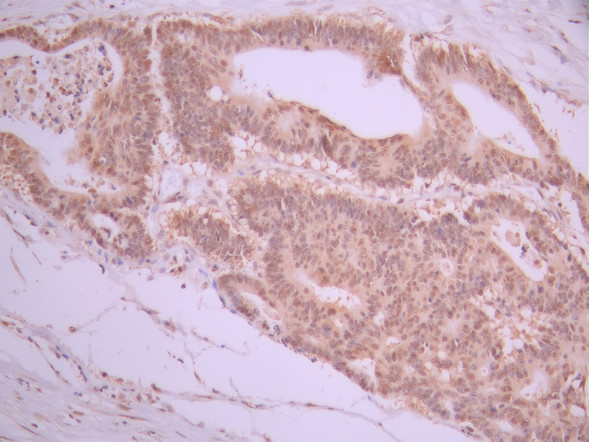
  • IHC image of CSB-RA269987A0HU diluted at 1:100 and staining in paraffin-embedded human colorectal cancer performed on a Leica BondTM system. After dewaxing and hydration, antigen retrieval was mediated by high pressure in a citrate buffer (pH 6.0). Section was blocked with 10% normal goat serum 30min at RT. Then primary antibody (1% BSA) was incubated at 4°C overnight. The primary is detected by a Goat anti-rabbit polymer IgG labeled by HRP and visualized using 0.05% DAB.
Have Questions? Leave a Message or Start an on-line Chat

Product Details

Uniprot No.
Target Names
SUPT5H
Alternative Names
DRB sensitivity inducing factor large subunit; DRB sensitivity-inducing factor 160 kDa subunit; DRB sensitivity-inducing factor large subunit; DSIF large subunit; DSIF p160; FLJ34157; hSPT 5; hSPT5; SPT 5; SPT 5H; SPT5; SPT5H; SPT5H_HUMAN; Suppressor of Ty 5 homolog; Suppressor of Ty 5 homolog (S. cerevisiae); SUPT 5H; supt5h; Tat cotransactivator 1 protein; Tat CT1; Tat CT1 protein; Tat-cotransactivator 1 protein; Tat-CT1 protein; Transcription elongation factor SPT 5; Transcription elongation factor spt5; Transcription factor Tat CT1
Species Reactivity
Human, Mouse
Immunogen
A synthesized peptide from human SUPT5H protein
Immunogen Species
Homo sapiens (Human)
Conjugate
Non-conjugated
Clonality
Monoclonal
Isotype
Rabbit IgG
Clone No.
21D1
Purification Method
Affinity-chromatography
Concentration
It differs from different batches. Please contact us to confirm it.
Buffer
Rabbit IgG in 10mM phosphate buffered saline , pH 7.4, 150mM sodium chloride, 0.05% BSA, 0.02% sodium azide and 50% glycerol.
Form
Liquid
Tested Applications
ELISA, WB, IHC
Recommended Dilution
Application Recommended Dilution
WB 1:500-1:5000
IHC 1:50-1:200
Troubleshooting and FAQs
Storage
Upon receipt, store at -20°C or -80°C. Avoid repeated freeze.
Lead Time
Basically, we can dispatch the products out in 1-3 working days after receiving your orders. Delivery time maybe differs from different purchasing way or location, please kindly consult your local distributors for specific delivery time.
Usage
For Research Use Only. Not for use in diagnostic or therapeutic procedures.

Customer Reviews and Q&A

 Customer Reviews

There are currently no reviews for this product.

Submit a Review here

Target Background

Function
Component of the DRB sensitivity-inducing factor complex (DSIF complex), which regulates mRNA processing and transcription elongation by RNA polymerase II. DSIF positively regulates mRNA capping by stimulating the mRNA guanylyltransferase activity of RNGTT/CAP1A. DSIF also acts cooperatively with the negative elongation factor complex (NELF complex) to enhance transcriptional pausing at sites proximal to the promoter. Transcriptional pausing may facilitate the assembly of an elongation competent RNA polymerase II complex. DSIF and NELF promote pausing by inhibition of the transcription elongation factor TFIIS/S-II. TFIIS/S-II binds to RNA polymerase II at transcription pause sites and stimulates the weak intrinsic nuclease activity of the enzyme. Cleavage of blocked transcripts by RNA polymerase II promotes the resumption of transcription from the new 3' terminus and may allow repeated attempts at transcription through natural pause sites. DSIF can also positively regulate transcriptional elongation and is required for the efficient activation of transcriptional elongation by the HIV-1 nuclear transcriptional activator, Tat. DSIF acts to suppress transcriptional pausing in transcripts derived from the HIV-1 LTR and blocks premature release of HIV-1 transcripts at terminator sequences.
Gene References into Functions
  1. These findings are consistent with a central role of Spt5 in maintenance of TFIID-promoter association and promoter escape to support rapid transcriptional induction and re-initiation of inflammatory-response genes. PMID: 27180651
  2. The mobile C-terminal region of DSIF is located near exiting RNA, where it can recruit factors for RNA processing. PMID: 28892040
  3. OGA is physically associated with the known RNA polymerase II (pol II) pausing/elongation factors SPT5 and TRIM28-KAP1-TIF1beta, and a purified OGA-SPT5-TIF1beta complex has elongation properties. PMID: 27601472
  4. A transcription-independent effect of tumor necrosis factor alpha on RNA splicing, mediated by Spt5. PMID: 26903558
  5. SPT5 contributes to the up-regulation of hTERT expression and colonic tumor development. PMID: 26418880
  6. Data indicate that the Plus3 domain of the Rtf1 subunit mediates Paf1C recruitment to genes by binding a repeating domain within the phosphorylated elongation factor Spt5. PMID: 24101474
  7. DSIF Is Selectively Required for mRNA Splicing and Export of NF-kappaB Target Genes. PMID: 23041311
  8. RNA polymerase II elongation repression is critically dependent on the C-terminus of Spt5 PMID: 19742326
  9. phosphorylated by P-TEFb kinase during HIV-1 transcription in Tat/TAR dependent manner PMID: 15564463
  10. hSpt5 function in transcription regulation and mRNA capping is essential for a subset of cellular and viral genes and may not be required for global gene expression. PMID: 15620346
  11. evolutionarily conserved repetitive heptapeptide motif (consensus = G-S-R/Q-T-P) in the C-terminal region of hSpt5, like the C-terminal domain of RNA Pol II, is highly phosphorylated by P-TEFb PMID: 16427012
  12. phosphorylation by cdk9; binds pin1 protein after phosphorylation PMID: 11575923

Show More

Hide All

Subcellular Location
Nucleus.
Protein Families
SPT5 family
Tissue Specificity
Ubiquitously expressed.
Database Links

HGNC: 11469

OMIM: 602102

KEGG: hsa:6829

STRING: 9606.ENSP00000404029

UniGene: Hs.631604

icon of phone
Call us
301-363-4651 (Available 9 a.m. to 5 p.m. CST from Monday to Friday)

icon of address
Address
7505 Fannin St., Ste 610, Room 7 (CUBIO Innovation Center), Houston, TX 77054, USA
icon of social media
Join us with

Subscribe newsletter

Leave a message

* To protect against spam, please pass the CAPTCHA test below.
CAPTCHA verification
© 2007-2026 CUSABIO TECHNOLOGY LLC All rights reserved. 鄂ICP备15011166号-1
Place an order now

I. Product details

*
*
*
*

II. Contact details

*
*

III. Ship To

*
*
*
*
*
*
*

IV. Bill To

*
*
*
*
*
*
*
*


