
Call us
301-363-4651 (Available 9 a.m. to 5 p.m. CST from Monday to Friday)

| Code | CSB-RA782443A0HU |
| Size | US$210 |
| Order now | |
| Image |
|
| Have Questions? | Leave a Message or Start an on-line Chat |
| Application | Recommended Dilution |
|---|---|
| WB | 1:500-1:5000 |
| IHC | 1:50-1:200 |
| FC | 1:50-1:200 |
TBL1XR1 (Transducin beta-like 1X-related protein 1) serves as a critical component of the nuclear receptor corepressor/HDAC3 complex, positioning it at the intersection of transcriptional regulation and chromatin remodeling. This protein functions as an exchange factor that facilitates the dismissal of corepressor complexes, enabling gene activation in response to nuclear receptor signaling. For researchers investigating epigenetic mechanisms, nuclear signaling pathways, or transcriptional control, TBL1XR1 represents a compelling target with implications across developmental biology and disease research.
This recombinant monoclonal antibody, generated from clone 14D7 in rabbit host, offers the reproducibility and consistency that demanding experimental workflows require. Because recombinant production ensures a sequence-defined antibody with minimal lot-to-lot variation, researchers can confidently build upon previous results and compare data across extended studies without concerns about reagent variability.
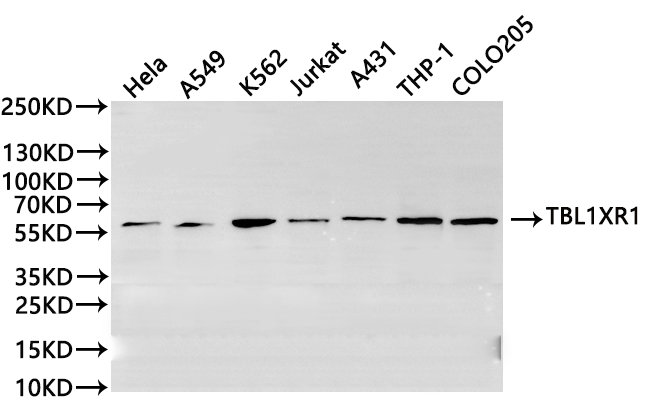
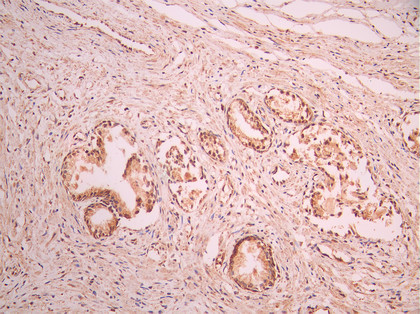
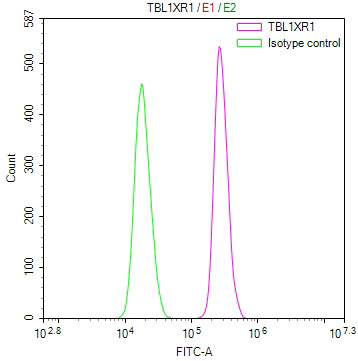
Validation data demonstrates robust performance across multiple applications. Western blot analysis confirms specific detection at the predicted 56 kDa molecular weight across a diverse panel of human cell lines, including HeLa, A549, K562, A2780, Jurkat, A431, THP-1, and COLO205 lysates, providing confidence when working with various cellular models. Immunohistochemistry validation in paraffin-embedded human prostate tissue shows clear staining using standard citrate buffer antigen retrieval protocols. Flow cytometry analysis in HeLa cells demonstrates distinct signal separation from isotype controls, supporting intracellular detection applications.
Whether examining corepressor complex dynamics, characterizing nuclear receptor signaling, or exploring chromatin-associated regulatory mechanisms, this antibody provides validated flexibility across western blotting, immunohistochemistry, and flow cytometry platforms for human sample analysis.
There are currently no reviews for this product.





