
Call us
301-363-4651 (Available 9 a.m. to 5 p.m. CST from Monday to Friday)

| Code | CSB-RA798840A0HU |
| Size | US$210 |
| Order now | |
| Image |
|
| Have Questions? | Leave a Message or Start an on-line Chat |
| Application | Recommended Dilution |
|---|---|
| IHC | 1:50-1:200 |
Telomerase reverse transcriptase (TERT) serves as the catalytic subunit of the telomerase ribonucleoprotein complex, directly responsible for adding telomeric repeats to chromosome ends. This enzymatic activity is largely silenced in normal somatic cells but becomes reactivated in approximately 90% of human cancers, making TERT a critical marker for understanding cellular immortalization and malignant transformation. Beyond oncology, TERT plays essential roles in stem cell maintenance and developmental biology, where telomerase activity supports the proliferative capacity of progenitor populations.
This recombinant monoclonal antibody, clone 5C11, offers researchers the consistency and reproducibility that recombinant technology provides. Generated against a synthetic peptide derived from human TERT and produced in rabbit host cells, the antibody delivers sequence-defined specificity with minimal lot-to-lot variation. This reliability is particularly valuable for longitudinal studies or multi-site collaborations where experimental consistency is paramount.
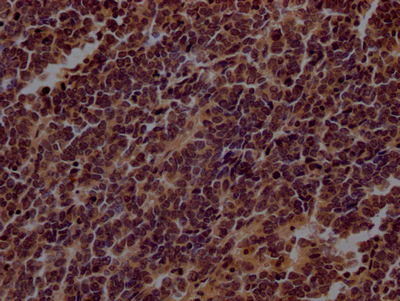
Validation in immunohistochemistry demonstrates effective detection in paraffin-embedded human lung cancer tissue, with recommended working dilutions of 1:50 to 1:200. The IHC protocol employed citrate buffer antigen retrieval at pH 6.0 under high pressure, followed by overnight primary antibody incubation at 4°C, yielding clear visualization via HRP-polymer detection and DAB chromogen development. The antibody is also validated for ELISA applications, providing flexibility across experimental platforms.
Supplied in a glycerol-containing buffer optimized for long-term stability at -20°C or -80°C, this antibody supports investigations into telomerase biology across cancer research, epigenetic regulation, and stem cell studies where understanding TERT expression patterns informs both basic mechanistic questions and translational applications.
There are currently no reviews for this product.





