
Call us
301-363-4651 (Available 9 a.m. to 5 p.m. CST from Monday to Friday)

| Code | CSB-RA931459A0HU |
| Size | US$210 |
| Order now | |
| Image |
|
| Have Questions? | Leave a Message or Start an on-line Chat |
| Application | Recommended Dilution |
|---|---|
| WB | 1:500-1:2000 |
| IF | 1:50-1:200 |
| FC | 1:50-1:200 |
Thymidine kinase 1 serves as a critical enzyme in the pyrimidine salvage pathway, phosphorylating thymidine to thymidine monophosphate during DNA synthesis. Its expression is tightly coupled to the cell cycle, peaking during S phase, which makes TK1 an established marker for cellular proliferation. This characteristic has positioned TK1 as a valuable target in cancer research, where elevated serum levels correlate with tumor burden and treatment response across multiple malignancies.
This recombinant monoclonal antibody, generated from clone 6F6, offers the reproducibility that demanding research applications require. Because recombinant technology produces antibodies from defined genetic sequences rather than hybridoma supernatants, you can expect consistent performance across experiments and between lot numbers. This sequence-defined production eliminates the variability that can compromise longitudinal studies or multi-site collaborations.
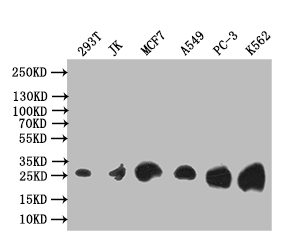
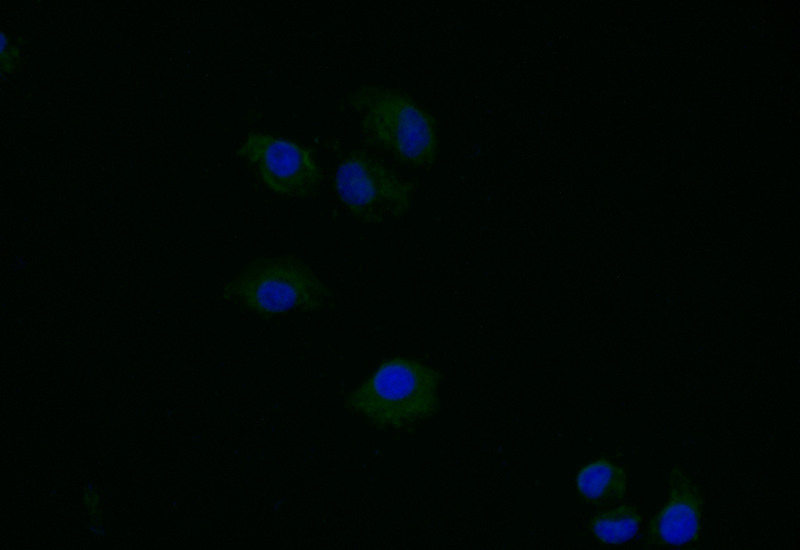
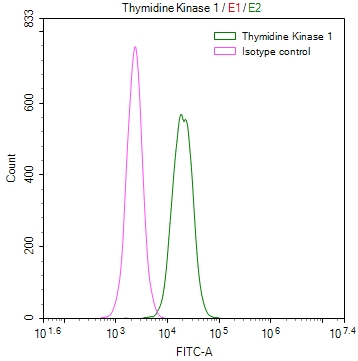
Validation across multiple platforms demonstrates this antibody's versatility in your workflow. Western blot analysis confirms specific detection of TK1 at the expected 26 kDa molecular weight across a diverse panel of human cell lines, including 293T, Jurkat, MCF7, A549, PC-3, and K562 cells. This broad validation across epithelial, hematopoietic, and transformed cell types provides confidence when working with various experimental models. Immunofluorescence staining in HeLa cells reveals the cytosolic localization pattern consistent with TK1's known cellular distribution, while flow cytometry analysis demonstrates clear separation between specific signal and isotype control, enabling quantitative assessment of TK1 expression at the single-cell level.
Whether you're investigating cell cycle dynamics, evaluating proliferation markers in cancer models, or exploring nucleotide metabolism, this antibody provides a reliable tool for studying TK1 biology across multiple experimental approaches.
There are currently no reviews for this product.





