
Call us
301-363-4651 (Available 9 a.m. to 5 p.m. CST from Monday to Friday)

| Code | CSB-RA995859A0HU |
| Size | US$210 |
| Order now | |
| Image |
|
| Have Questions? | Leave a Message or Start an on-line Chat |
| Application | Recommended Dilution |
|---|---|
| WB | 1:500-1:5000 |
| IHC | 1:50-1:200 |
| FC | 1:50-1:200 |
TXNDC12, also known as ERp19 or thioredoxin-like protein p19, is an endoplasmic reticulum-resident protein belonging to the thioredoxin superfamily. This 19 kDa protein functions as a protein disulfide isomerase, playing essential roles in oxidative protein folding and redox homeostasis within the ER. Its involvement in maintaining proper protein folding makes TXNDC12 a relevant target for researchers investigating ER stress responses, signal transduction pathways, and cellular redox regulation.
This recombinant monoclonal antibody, generated from clone 21A7, offers the reproducibility and consistency that demanding experimental workflows require. Because the antibody sequence is defined and produced recombinantly in rabbit host, researchers benefit from lot-to-lot uniformity that supports longitudinal studies and ensures comparable results across experiments. Affinity chromatography purification further enhances specificity and reduces background interference.
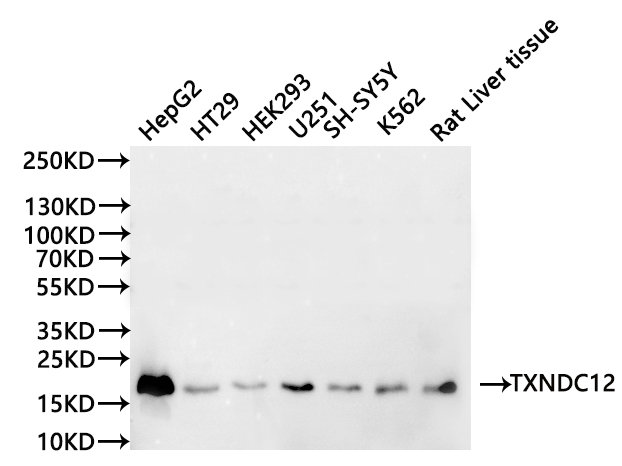
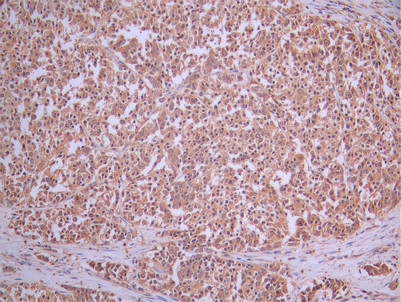
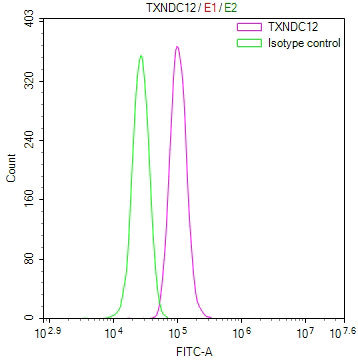
Validation studies demonstrate robust performance across multiple applications. Western blot analysis confirms detection of the expected 19 kDa band across diverse human cell lines including HepG2, HT-29, HEK293, U-251MG, SH-SY5Y, and K562, with cross-species reactivity confirmed in rat liver tissue. This breadth of validated sample types provides flexibility for comparative studies across different cellular models. Immunohistochemistry staining in paraffin-embedded human liver cancer tissue shows clear target visualization, while flow cytometry analysis in HepG2 cells demonstrates suitability for single-cell studies requiring intracellular protein detection.
The unconjugated format allows researchers to pair this antibody with their preferred detection systems across ELISA, western blot, immunohistochemistry, and flow cytometry applications. For investigators exploring ER function, protein folding mechanisms, or signal transduction pathways, this antibody delivers the technical reliability needed for meaningful experimental outcomes.
There are currently no reviews for this product.





