
Call us
301-363-4651 (Available 9 a.m. to 5 p.m. CST from Monday to Friday)

| Code | CSB-RA036685A0HU |
| Size | US$210 |
| Order now | |
| Image |
|
| Have Questions? | Leave a Message or Start an on-line Chat |
| Application | Recommended Dilution |
|---|---|
| IF | 1:50-1:200 |
| FC | 1:50-1:200 |
Ubiquitin B represents one of the most evolutionarily conserved proteins across eukaryotes, serving as the fundamental building block of the ubiquitin-proteasome system. This polyubiquitin precursor is cleaved to generate functional ubiquitin monomers that orchestrate protein degradation, cell cycle regulation, DNA repair, and signal transduction pathways. Dysregulation of ubiquitin homeostasis has been implicated in neurodegenerative diseases, cancer progression, and immune dysfunction, making UBB a compelling target for researchers investigating proteostasis and cellular stress responses.
This recombinant monoclonal antibody, clone 18C12, offers the reproducibility that demanding experimental workflows require. Generated against a synthetic peptide derived from human UBB, the antibody is produced using recombinant technology, ensuring sequence-defined consistency between lots. This eliminates the variability inherent in traditional hybridoma-derived antibodies, allowing researchers to confidently compare results across extended studies and collaborative projects.
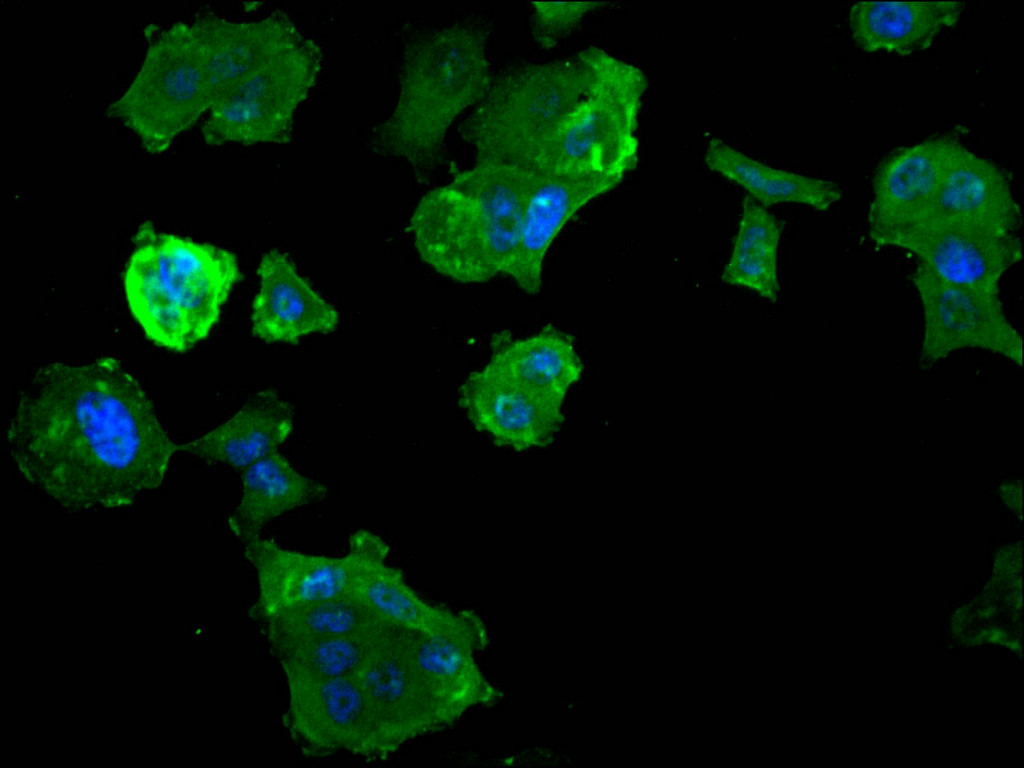
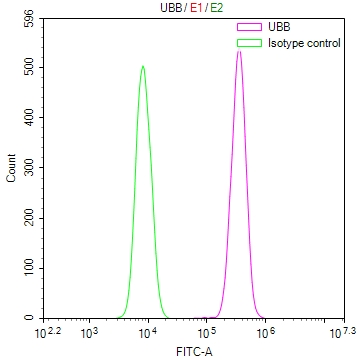
Validation studies demonstrate robust performance in immunofluorescence and flow cytometry applications. Immunofluorescence staining of MCF-7 breast cancer cells reveals clear signal with recommended dilutions of 1:50–1:200, while flow cytometric analysis of HeLa cells shows distinct positive population shifts compared to isotype controls. These validated human cell lines provide researchers with established starting points for their own experimental optimization.
The antibody is supplied in a stabilized liquid format containing glycerol for long-term storage stability at -20°C or -80°C. Affinity purification ensures high specificity for downstream applications. Whether investigating ubiquitin dynamics in cancer biology, exploring protein quality control mechanisms, or characterizing cellular stress responses, this antibody provides a reliable tool for visualizing and quantifying UBB expression at the single-cell level.
There are currently no reviews for this product.





