
Call us
301-363-4651 (Available 9 a.m. to 5 p.m. CST from Monday to Friday)

| Code | CSB-RA119872A0HU |
| Size | US$210 |
| Order now | |
| Image |
|
| Have Questions? | Leave a Message or Start an on-line Chat |
| Application | Recommended Dilution |
|---|---|
| WB | 1:500-1:2000 |
| FC | 1:50-1:200 |
XBP1 (X-box-binding protein 1) serves as a master regulator of the unfolded protein response, playing a critical role in endoplasmic reticulum stress signaling and cellular adaptation to proteotoxic conditions. This transcription factor has garnered significant research attention for its involvement in plasma cell differentiation, metabolic regulation, and its emerging connections to cancer biology and inflammatory diseases. The unconventional splicing of XBP1 mRNA by IRE1α generates the active transcription factor, making it a key node in understanding how cells manage protein folding capacity.
This recombinant monoclonal antibody, clone 1C8, offers the reproducibility and consistency that demanding experimental workflows require. Because it is produced from a defined sequence in a controlled expression system, researchers can expect reliable performance across experiments and between lots, eliminating the variability often encountered with traditional hybridoma-derived antibodies. The rabbit IgG format provides excellent signal-to-noise characteristics for detection applications.
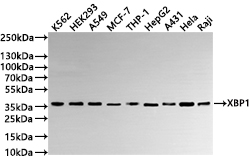
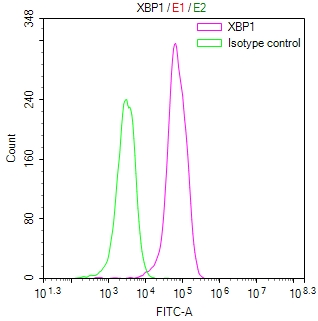
Validation studies demonstrate robust performance in Western blot analysis across a diverse panel of human cell lines, including K562, HEK293, A549, MCF-7, THP-1, HepG2, A431, HeLa, and Raji cells. The observed band size of approximately 35 kDa, compared to the predicted 29 kDa molecular weight, likely reflects post-translational modifications characteristic of this transcription factor. Flow cytometry validation in MCF-7 cells confirms utility for intracellular detection of XBP1, expanding experimental options for researchers studying ER stress responses at the single-cell level.
This antibody supports investigations into UPR signaling, secretory cell biology, metabolic stress responses, and the growing body of research connecting XBP1 function to disease mechanisms in oncology and immunology.
There are currently no reviews for this product.





