
Call us
301-363-4651 (Available 9 a.m. to 5 p.m. CST from Monday to Friday)

| Code | CSB-RA115871A0HU |
| Size | US$210 |
| Order now | |
| Image |
|
| Have Questions? | Leave a Message or Start an on-line Chat |
| Application | Recommended Dilution |
|---|---|
| WB | 1:500-1:2000 |
| IHC | 1:50-1:200 |
| FC | 1:50-1:200 |
YWHAE, also known as 14-3-3 protein epsilon, belongs to the highly conserved 14-3-3 protein family that plays essential roles in signal transduction, cell cycle regulation, and apoptotic pathways. Through phosphoserine/phosphothreonine-binding interactions, YWHAE modulates the activity of numerous signaling proteins, making it a significant target in cancer biology, neuroscience, and cell signaling research.
This recombinant monoclonal antibody, generated from clone 8D9, offers the reproducibility and consistency that demanding experimental workflows require. Because the antibody sequence is defined and produced recombinantly in rabbit host, researchers benefit from lot-to-lot uniformity that eliminates the variability often encountered with traditional hybridoma-derived antibodies. This reliability is particularly valuable for longitudinal studies or when standardizing protocols across research groups.
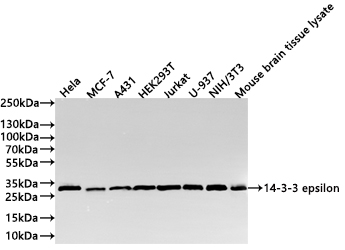
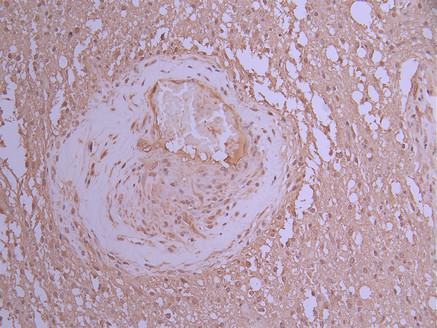
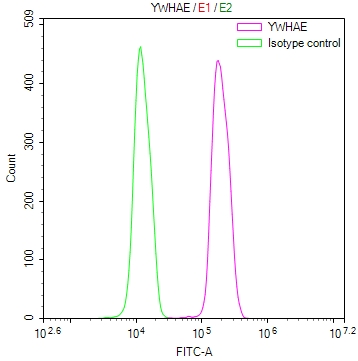
Validation data demonstrates robust performance across multiple applications. In western blot analysis, the antibody detects a clean 29 kDa band matching the predicted molecular weight of YWHAE, confirmed across an extensive panel of human cell lines including HeLa, MCF-7, A431, HEK293T, Jurkat, and U-937. Cross-species reactivity with mouse samples has been validated in both NIH/3T3 cells and mouse brain tissue lysate, supporting translational research using murine models. Immunohistochemistry staining in paraffin-embedded human glioma tissue reveals clear target localization, while flow cytometry analysis in HeLa cells shows distinct positive signal separation from isotype controls.
The antibody's versatility across western blot, immunohistochemistry, and flow cytometry applications provides flexibility for researchers investigating 14-3-3 protein function in oncology, neurodegeneration, or fundamental cell biology studies where consistent, reliable detection of YWHAE is essential.
There are currently no reviews for this product.





