
Call us
301-363-4651 (Available 9 a.m. to 5 p.m. CST from Monday to Friday)

| Code | CSB-RA964866A0HU |
| Size | US$210 |
| Order now | |
| Image |
|
| Have Questions? | Leave a Message or Start an on-line Chat |
| Application | Recommended Dilution |
|---|---|
| IHC | 1:50-1:200 |
| FC | 1:50-1:200 |
ZEB1 serves as a master transcriptional regulator of epithelial-mesenchymal transition, a process central to embryonic development, wound healing, and cancer metastasis. This zinc finger E-box-binding homeobox protein represses E-cadherin expression and drives cells toward mesenchymal phenotypes, making it a critical marker for studying tumor invasion, drug resistance mechanisms, and stem cell plasticity.
This recombinant monoclonal antibody, clone 10C4, offers the reproducibility essential for longitudinal studies and multi-site collaborations. Generated against a synthesized peptide from human ZEB1 protein, the sequence-defined nature of recombinant production ensures consistent epitope recognition across lots, eliminating the variability that can compromise experimental comparisons over time. Affinity chromatography purification delivers a clean reagent suitable for demanding applications.
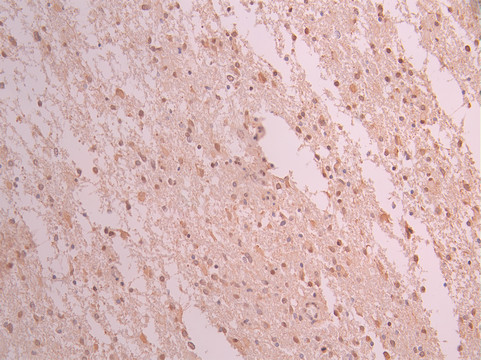
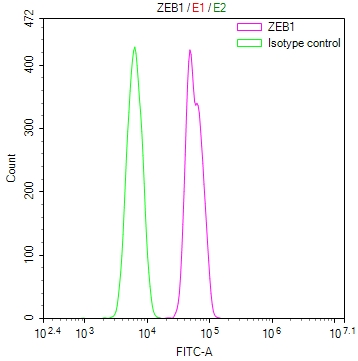
Validation across multiple platforms demonstrates versatility in your experimental workflow. Immunohistochemistry testing in paraffin-embedded human glioma tissue at 1:100 dilution reveals clear nuclear staining patterns consistent with ZEB1's role as a transcription factor, with the citrate buffer antigen retrieval protocol optimized for formalin-fixed samples. Flow cytometry analysis using SH-SY5Y neuroblastoma cells confirms intracellular detection capability, with the overlay histogram showing distinct positive signal separation from isotype control when cells are properly fixed and permeabilized.
The antibody's reactivity with human samples and its performance in both tissue sections and cultured cell lines positions it well for cancer biology research, particularly investigations into EMT dynamics, neural crest development, and therapeutic resistance mechanisms. Whether examining ZEB1 expression in clinical specimens or tracking phenotypic transitions in cell culture models, this reagent provides the technical foundation for meaningful biological insights.
There are currently no reviews for this product.





