
Call us
301-363-4651 (Available 9 a.m. to 5 p.m. CST from Monday to Friday)

Have you ever had to scale back a promising experiment because the therapeutic antibody you needed was too expensive? You're not alone. Budget constraints force many researchers to compromise—fewer replicates, smaller pilot studies, or shelved exploratory work. This financial bottleneck fundamentally limits the pace and potential of discovery.
The emergence of research-level biosimilar antibodies has addressed the high cost of therapeutic antibodies. By providing a cost-effective, functionally similar alternative to pricey originator biologics, research-grade biosimilar antibodies remove a key barrier to robust, iterative science. This article will explain how these accessible tools can empower your work in mechanistic studies, assay development, and pharmacokinetic (PK) research.
Table of Contents
1. What Are Research-Grade Biosimilar Antibodies?
2. Why Do Research-Grade Biosimilar Antibodies Matter?
3. How Are Research-Grade Biosimilar Antibodies Used in Key Research Areas?
4. How Do You Select the Right Research-Grade Biosimilar Antibody for Your Experiment?
Research-grade biosimilar antibodies are recombinant monoclonal antibodies that replicate the variable region sequences of the approved originator biologics (reference products) or biosimilars. They are specifically produced for preclinical research and are not subject to the regulatory pathways required for therapeutic antibodies.
Research-grade biosimilar antibodies serve as critical tools across the therapeutic R&D continuum. Their primary applications encompass in vitro functional validation and mechanistic studies, serving as reference standards for PK/ADA assay development in drug development and quality control, acting as reliable positive controls in diagnostic and assay platforms (e.g., FC, IHC), and, with suitable formulations, enabling direct efficacy and dose-finding studies in preclinical animal models.
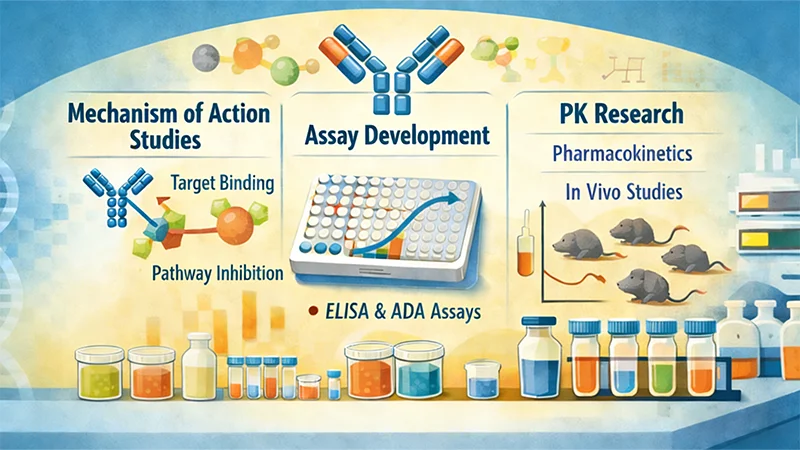
Figure: Applications of Research-grade biosimilar antibody
Comparisons among research-grade biosimilar antibodies, originator biologics, and clinical biosimilars:
| Aspect | Research-Grade Biosimilar Antibodies | Originator Biologics | Clinical Biosimilars |
|---|---|---|---|
| Definition | Antibodies designed for research use, structurally/functionally similar to an originator biologic. | Original, innovator biologic antibodies developed and approved for clinical treatment. | Approved biologic products highly similar to an originator biologic in terms of safety, purity, and efficacy. |
| Primary Use | Non-clinical research (e.g., in vitroassays, animal studies). | Therapeutic use in patients (approved indications). | Therapeutic use in patients (same indications as originator). |
| Regulatory Pathway | No regulatory approval required (often labeled "Research Use Only" or "RUO"). | Full regulatory review (e.g., FDA BLA, EMA MAA) with clinical trials. | Abbreviated regulatory pathway demonstrating comparability to the originator. |
| Similarity Requirements | High functional similarity (target specificity and functional activity); minor variations acceptable for research. | N/A (reference product). | Must demonstrate no clinically meaningful differences in terms of quality attributes, efficacy, safety, and immunogenicity compared to the reference originator biologic [1]. |
| Manufacturing Standards | Quality controlled, but not necessarily GMP; ISO standards common. | Strict GMP (Good Manufacturing Practice) compliance. | Strict GMP compliance, with comparability studies to originator. |
| Cost | Lower cost, affordable for labs. | High cost (reflects R&D, clinical trials, and patent exclusivity). | Lower cost than originator (due to abbreviated development). |
| Clinical Data Required | None. | Extensive preclinical and clinical data (safety/efficacy). | Comparative clinical studies focused on similarity, not re-establishing efficacy. |
| Intellectual Property | May avoid patent issues via research-only focus or off-patent targets. | Protected by patents and data exclusivity. | Marketed after originator's patent/exclusivity expires; must navigate IP landscape. |
| Key Goal | Enable affordable, reproducible research. | Provide safe and effective treatment for diseases. | Increase access to biologic therapies through competition. |
Research-grade biosimilar antibodies prioritize the level of characterization required for robust laboratory experiments over patient treatment [2]. Originator biologics are the original approved biologics, backed by full clinical data and patent protection. Clinical biosimilars are approved therapeutics that must demonstrate high similarity to the originator biologic, following a streamlined regulatory process.
For the early-career researcher, research-grade biosimilar antibodies matter because they directly address two fundamental constraints: budget and risk. They transform inaccessible, high-cost science into a more manageable and iterative process. By providing a viable alternative to originator biologics, they empower you to pursue more robust experimental designs and exploratory work that might otherwise be impossible, effectively accelerating your research trajectory from idea to data.
Originator therapeutic antibodies are famously expensive, often putting them out of reach for the scale of experimentation needed for thorough, publishable science. Research-grade biosimilar antibodies break down this financial barrier. The significant cost savings allow you to:
This accessibility effectively levels the playing field, enabling more rigorous and creative research.
Beyond cost, research-grade biosimilar antibodies serve as a strategic tool for project planning. Using them for preliminary work de-risks your entire experimental timeline. You can first use research-grade biosimilar antibodies to:
In practical terms, it means early-career researchers can refine methods and hypotheses before they reach for the most constrained therapeutic biologics [3,4]. It turns a high-stakes, one-attempt workflow into a more iterative and confident process.
Research-grade biosimilar antibodies enable foundational work to understand how an antibody drug works, develop tools to measure it, and predict its behavior in a living system. By serving as a functional stand-in, they allow researchers to generate robust, preliminary data and optimize methods efficiently.
Research-grade biosimilar antibodies are indispensable for elucidating the mechanism of action of therapeutic antibodies because they provide an analytically validated, structurally faithful model of the originator drug. Research-grade biosimilar antibodies can be used to explore these mechanisms in a way that closely reflects clinical agents:
Neutralization of Target-Mediated Signaling: A primary therapeutic function of many antibodies is to block the biological activity of their target. Research-grade biosimilars can be used to probe:
① Inhibition of Apoptosis: Testing the neutralization of antigen-induced cytotoxicity (e.g., TNFα-induced cell death).
② Suppression of Inflammatory Signaling: Evaluating the antibody's ability to inhibit antigen-induced production of downstream effector molecules, such as chemokines.
③ Blockade of Apoptotic Pathways: Assessing neutralization of antigen-induced caspase activation, a key step in programmed cell death.
④ Ligand Specificity: Testing neutralization against related ligands (e.g., both TNFα and lymphotoxin-α) to confirm specificity and breadth of activity.
Fc-Mediated Effector Functions: The crystallizable fragment (Fc) region of an antibody dictates its interactions with the immune system. Probing these functions is critical for antibodies whose mechanism includes immune cell recruitment.
① Fc Gamma Receptor (FcγR) Binding: Comparing binding affinity to various Fcγ receptors (e.g., FcγRI, FcγRIIa, FcγRIIIa variants) is necessary to predict interactions with immune cells like macrophages, neutrophils, and natural killer cells.
② Antibody-Dependent Cellular Cytotoxicity (ADCC): Directly measuring the antibody's ability to direct immune cells to kill target cells is a key effector function for some therapeutic antibodies.
③ Complement-Dependent Cytotoxicity (CDC): Evaluating the antibody's capacity to activate the complement cascade, leading to target cell lysis.
④ Neonatal Fc Receptor (FcRn) Binding: Assessing binding to FcRn is vital for understanding the antibody's pharmacokinetics, as this interaction regulates serum half-life by recycling antibodies from degradation.
By comparing results to originator antibodies, scientists can verify mechanistic insights—such as how a drug inhibits a receptor or modulates immune responses—in a cost-effective manner, accelerating early-stage mechanistic validation.
Bioanalytical strategies for monoclonal antibodies—especially in the context of biosimilars—place strong emphasis on ligand-binding assays, cell-based potency assays, and immunogenicity assays [e.g., anti-drug antibody (ADA)], all underpinned by well-characterized reference reagents.
In this framework, research-grade biosimilar antibodies can play several roles:
For ADA and immunogenicity methods, regulatory and review articles describe how anti-drug antibodies and “drug” surrogates are used to evaluate sensitivity, drug tolerance, and specificity. Research-grade biosimilar antibodies can function as such surrogates during early, non-regulated method development, so that assay formats are well understood before they are applied to preclinical or clinical samples [1,3].
In short, research-grade biosimilar antibodies align with the assay-centric, data-rich bioanalytical strategy seen in biosimilar development—only in this case, they are used in exploratory and preclinical workflows rather than formal regulatory packages.
Mechanistic PK models for therapeutic antibodies and their ADAs, published in journals such as Clinical Pharmacokinetics and related venues, highlight how PK and immunogenicity data are combined to understand antibody disposition and to assess biosimilarity. Early in development, nonclinical PK studies help identify half-life, clearance, and distribution patterns before larger trials are undertaken [3,4].
Research-grade biosimilar antibodies can support this foundational work in two ways:
These applications do not replace formal PK similarity studies, but help you refine tools and expectations early, which is exactly how the biosimilar literature suggests complex programs should be built—stepwise, from robust preclinical and analytical foundations to clinical evaluation.
Choosing the right research-grade biosimilar antibody requires careful evaluation beyond price alone. The goal is to identify a well-characterized tool that yields reliable, reproducible data for your specific application. This involves scrutinizing the analytical data provided by the supplier and assessing their scientific credibility and support. A rigorous selection process upfront saves valuable time and resources by preventing experimental failures later on.
Reviews in Nature Reviews Drug Discovery and related journals are clear that, for biosimilars, analytical and functional similarity underpin any meaningful comparison. The same logic applies when you are choosing a research-grade biosimilar antibody [4,5].
Key elements to look for in vendor documentation include:
These data types mirror those used to characterize therapeutic biosimilars and, when applied at the RUO level, help ensure that the reagent you choose is a credible proxy for the drug biology described in high-impact oncology and immunology reviews.
Because research-grade biosimilar antibodies are not regulated products, the depth of characterization and support can vary. Drawing on principles from biosimilar development and analytical strategy, it is reasonable to ask suppliers:
These questions echo the focus on robustness, reproducibility, and traceable characterization that is highlighted across the biosimilar and monoclonal antibody literature.
Scientific and regulatory reviews make a strong case that biosimilar monoclonal antibodies rely on a deep analytical and functional understanding and can broaden access to biologic mechanisms in the clinic. Research-grade biosimilar antibodies extend this idea into everyday research: they take the same logic of similarity and apply it to RUO reagents that can be used flexibly at the bench.
For early-career researchers, this opens up practical possibilities. You can probe mechanisms of action with research-grade biosimilar antibodies, build and refine assays in line with bioanalytical best practices, and explore foundational PK questions before originator material arrives. Rather than being mere substitutes, research-grade biosimilar antibodies serve as strategic enablers, making rigorous, reproducible, and innovative experiments more achievable.
Used thoughtfully and selected on the basis of solid analytical and functional evidence, these tools can help accelerate your projects and support more informed contributions to therapeutic antibody development.
CUSABIO has developed a diverse portfolio of research-grade biosimilar antibodies against various high-value targets, including immune checkpoints, tumor drivers, and neurological markers. They are recombinantly expressed in mammalian cells with unmodified variable and Fc regions identical to the approved therapeutic antibodies and are functionally validated with strong target-binding activity. They are suitable for direct application as positive controls in drug screening or for the rapid functional verification of target proteins.
References
[1] Kaida-Yip, F., Deshpande, K., Saran, T., & Vyas, D. (2018). Biosimilars: Review of current applications, obstacles, and their future in medicine [J]. World Journal of Clinical Cases, 6(8), 161.
[2] Declerck, P., Danesi, R., Petersel, D., & Jacobs, I. (2017). The Language of Biosimilars: Clarification, Definitions, and Regulatory Aspects [J]. Drugs, 77(6), 671.
[3] Liao, K. H., Udata, C., Yin, D., Sewell, K. L., Kantaridis, C., Alvarez, D. F., & Meng, X. (2020). A mechanistic pharmacokinetic model with drug and antidrug antibody interplay, and its application for assessing the impact of immunogenicity response on bioequivalence testing [J]. British Journal of Clinical Pharmacology, 86(11), 2182.
[4] Udpa, N., Million, R. Monoclonal antibody biosimilars [J]. Nat Rev Drug Discov 15, 13–14 (2016).
[5] Galvão, T. F., Livinalli, A., Lopes, L. C., Zimmermann, I. R., & Silva, M. T. (2020). Biosimilar monoclonal antibodies for cancer treatment [J]. The Cochrane Database of Systematic Reviews, 2020(2), CD013539.



Comments
Leave a Comment