
Call us
301-363-4651 (Available 9 a.m. to 5 p.m. CST from Monday to Friday)

| Code | CSB-BP342271HU |
| Abbreviation | Recombinant Human GNAQ protein |
| MSDS | |
| Size | $472 |
| Order now | |
| Image |
|
| Have Questions? | Leave a Message or Start an on-line Chat |
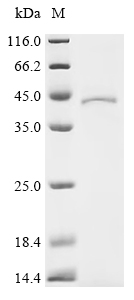
Recombinant Human Guanine nucleotide-binding protein G(q) subunit alpha (GNAQ) is produced through a baculovirus expression system, spanning the complete protein sequence from amino acids 1 to 359. The protein carries a C-terminal 10xHis-tag, which streamlines purification and detection processes. SDS-PAGE analysis confirms purity levels above 95%, suggesting this preparation should work well for research requiring high-quality protein samples.
GNAQ appears to be a key player in G protein-coupled receptor signaling pathways. The protein seems essential for intracellular signaling cascades, helping relay chemical messages from the cell surface inward and influencing numerous physiological processes. Given its central role in signal transduction, GNAQ has become a major focus for researchers studying how cells communicate and respond to their environment.
Potential Applications
Note: The applications listed below are based on what we know about this protein's biological functions, published research, and experience from experts in the field. However, we haven't fully tested all of these applications ourselves yet. We'd recommend running some preliminary tests first to make sure they work for your specific research goals.
The Baculovirus system is superior to prokaryotic systems for expressing complex eukaryotic proteins like GNAQ, as it provides a more suitable environment for folding, disulfide bond formation, and potential post-translational modifications. The C-terminal His tag is less likely to interfere with the N-terminal functional domains of G-protein alpha subunits. While the high purity is favorable, GNAQ requires precise folding for its GTPase activity, interaction with GPCRs and effectors, and proper membrane association (though the latter may be affected without lipidation). Without explicit activity validation (e.g., GTP binding or effector interaction assays), the protein's bioactivity cannot be guaranteed, but the expression system suggests a higher probability of correct folding compared to bacterial systems.
1. Protein-Protein Interaction Studies Using His-Tag Pull-Down Assays
This application is feasible, as the His-tag enables pull-down assays. However, the protein's ability to interact with physiological partners (e.g., GPCRs, effectors like PLCβ) depends on correct folding and activation state (GTP-bound). If the protein is misfolded or inactive, interactions may be non-physiological. Validate any identified interactions using complementary methods (e.g., co-immunoprecipitation from mammalian cells) and confirm the protein's activity (e.g., GTPγS binding) beforehand.
2. Antibody Development and Validation
This high-purity, full-length GNAQ is an excellent immunogen for antibody production. The full-length sequence presents multiple epitopes. However, antibodies generated against this recombinant form may not recognize the native, lipidated (palmitoylated) form of GNAQ in mammalian cells, or specific activation-state conformations. Validate antibody specificity against endogenous GNAQ in mammalian cell lysates or tissues.
3. Biochemical Characterization and Enzyme Kinetics Studies
The protein is highly suitable for detailed biophysical characterization (e.g., thermal stability, oligomerization state). However, for enzyme kinetics, it is crucial to first confirm GTPase activity. Without confirmed activity, kinetic parameters (kcat, Km for GTP) are meaningless. Studies on stability and solution behavior are valid regardless, but interpret structural data with the understanding that the C-terminal tag is present and lipidation may be absent.
4. In Vitro Binding Assays with Small Molecules and Inhibitors
This application is highly dependent on confirmed bioactivity. For screening small molecules or measuring inhibitor binding (e.g., using SPR), the protein must be correctly folded and capable of GTP binding. An inactive protein will yield false negatives or non-specific binding. Prioritize validating GTPγS binding activity before any binding assays. The His-tag is advantageous for immobilization in SPR.
Final Recommendation & Action Plan
Before using this recombinant GNAQ for functional studies, it is essential to validate its folding and bioactivity. Start by confirming its GTP-binding capability using a GTPγS binding assay or similar method. If active, proceed with interaction or inhibitor screening studies, but always include appropriate controls (e.g., GDP-bound state, known inhibitors). For antibody development, proceed with immunization but rigorously validate the antibodies against native GNAQ in complex cellular environments. For biophysical characterization, the protein can be used directly, but acknowledge the potential structural impact of the C-terminal tag and the likely absence of native lipidation. The Baculovirus system offers a strong foundation for obtaining a functional protein, but experimental validation remains the critical first step.
There are currently no reviews for this product.





