Recombinant Human Long-chain-fatty-acid--CoA ligase 6 (ACSL6), partial

Code CSB-EP892139HU
Abbreviation Recombinant Human ACSL6 protein, partial
MSDS
Size $256
Order now
Image
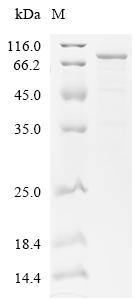
  • (Tris-Glycine gel) Discontinuous SDS-PAGE (reduced) with 5% enrichment gel and 15% separation gel.
Have Questions? Leave a Message or Start an on-line Chat

Product Details

Purity
Greater than 85% as determined by SDS-PAGE.
Activity
Not Test
Target Names
Uniprot No.
Research Area
Cancer
Alternative Names
Arachidonate--CoA ligase;Long-chain acyl-CoA synthetase 6
Species
Homo sapiens (Human)
Source
E.coli
Expression Region
46-697aa
Target Protein Sequence
HRPKALQPPCNLLMQSEEVEDSGGARRSVIGSGPQLLTHYYDDARTMYQVFRRGLSISGNGPCLGFRKPKQPYQWLSYQEVADRAEFLGSGLLQHNCKACTDQFIGVFAQNRPEWIIVELACYTYSMVVVPLYDTLGPGAIRYIINTADISTVIVDKPQKAVLLLEHVERKETPGLKLIILMDPFEEALKERGQKCGVVIKSMQAVEDCGQENHQAPVPPQPDDLSIVCFTSGTTGNPKGAMLTHGNVVADFSGFLKVTEKVIFPRQDDVLISFLPLAHMFERVIQSVVYCHGGRVGFFQGDIRLLSDDMKALCPTIFPVVPRLLNRMYDKIFSQANTPLKRWLLEFAAKRKQAEVRSGIIRNDSIWDELFFNKIQASLGGCVRMIVTGAAPASPTVLGFLRAALGCQVYEGYGQTECTAGCTFTTPGDWTSGHVGAPLPCNHIKLVDVEELNYWACKGEGEICVRGPNVFKGYLKDPDRTKEALDSDGWLHTGDIGKWLPAGTLKIIDRKKHIFKLAQGEYVAPEKIENIYIRSQPVAQIYVHGDSLKAFLVGIVVPDPEVMPSWAQKRGIEGTYADLCTNKDLKKAILEDMVRLGKESGLHSFEQVKAIHIHSDMFSVQNGLLTPTLKAKRPELREYFKKQIEELYSISM
Note: The complete sequence may include tag sequence, target protein sequence, linker sequence and extra sequence that is translated with the protein sequence for the purpose(s) of secretion, stability, solubility, etc.
If the exact amino acid sequence of this recombinant protein is critical to your application, please explicitly request the full and complete sequence of this protein before ordering.
Mol. Weight
79.6 kDa
Protein Length
Partial
Tag Info
C-terminal 6xHis-tagged
Form
Liquid or Lyophilized powder
Note: We will preferentially ship the format that we have in stock, however, if you have any special requirement for the format, please remark your requirement when placing the order, we will prepare according to your demand.
Buffer
If the delivery form is liquid, the default storage buffer is Tris/PBS-based buffer, 5%-50% glycerol. If the delivery form is lyophilized powder, the buffer before lyophilization is Tris/PBS-based buffer, 6% Trehalose, pH 8.0.
Reconstitution
We recommend that this vial be briefly centrifuged prior to opening to bring the contents to the bottom. Please reconstitute protein in deionized sterile water to a concentration of 0.1-1.0 mg/mL.We recommend to add 5-50% of glycerol (final concentration) and aliquot for long-term storage at -20℃/-80℃. Our default final concentration of glycerol is 50%. Customers could use it as reference.
Troubleshooting and FAQs
Storage Condition
Store at -20°C/-80°C upon receipt, aliquoting is necessary for mutiple use. Avoid repeated freeze-thaw cycles.
Shelf Life
The shelf life is related to many factors, storage state, buffer ingredients, storage temperature and the stability of the protein itself.
Generally, the shelf life of liquid form is 6 months at -20°C/-80°C. The shelf life of lyophilized form is 12 months at -20°C/-80°C.
Lead Time
Basically, we can dispatch the products out in 3-7 working days after receiving your orders. Delivery time may differ from different purchasing way or location, please kindly consult your local distributors for specific delivery time.
Notes
Repeated freezing and thawing is not recommended. Store working aliquots at 4℃ for up to one week.
Datasheet & COA
Please contact us to get it.
Customer Reviews and Q&A

 Customer Reviews

There are currently no reviews for this product.

Submit a Review here

Target Background

Function
Catalyzes the conversion of long-chain fatty acids to their active form acyl-CoA for both synthesis of cellular lipids, and degradation via beta-oxidation. Plays an important role in fatty acid metabolism in brain and the acyl-CoAs produced may be utilized exclusively for the synthesis of the brain lipid.
Gene References into Functions
  1. ACSL6 drives acyl-CoA toward lipid synthesis and its downregulation improves mitochondrial biogenesis, respiratory capacity and lipid oxidation PMID: 27647415
  2. variations in the ACSL6 gene may contribute to the quantity of cigarettes smoked PMID: 22205969
  3. The alternative fatty acid Gate-domain motifs are essential determinants for the activity of the human ACSL6 isoforms, which appear to act as homodimeric enzyme as well as in complex with other spliced forms. PMID: 20429931
  4. The t(5;12)(q23-31;p13)translocation with ETV6-ACSL6 genomic alteration rearrangement in polycythemia vera patients was reported. PMID: 16572202
  5. Analyses did not yield convincing evidence for associations of schizophrenia with ACSL6 PMID: 16827919
  6. Three ACSL6 spliced variants of a mutually exclusive exon pair are reported, they encode a slightly different short motif which contains a conserved structural domain, the fatty acid Gate domain. PMID: 16834775
  7. haplotypes underlying the SPEC2/PDZ-GEF2/ACSL6 region are associated with schizophrenia PMID: 17030554
  8. The acyl-coenzyme A synthetase long-chain family member 6 (ACSL6) gene on chromosome 5q31 was associated with premature ovarian failure and identified disease-susceptibility haplotypes. PMID: 18555221
  9. ACSL6 is highly associated with schizophrenia and several haplotypes in this haploblock have about twofold to 10-fold increase in the affected subjects in Han Chinese. PMID: 18718982

Show More

Hide All

Involvement in disease
A chromosomal aberration involving ACSL6 may be a cause of myelodysplastic syndrome with basophilia. Translocation t(5;12)(q31;p13) with ETV6.
Subcellular Location
Mitochondrion outer membrane; Single-pass type III membrane protein. Peroxisome membrane; Single-pass type III membrane protein. Microsome membrane; Single-pass type III membrane protein. Endoplasmic reticulum membrane; Single-pass type III membrane protein.
Protein Families
ATP-dependent AMP-binding enzyme family
Tissue Specificity
Expressed predominantly in erythrocyte precursors, in particular in reticulocytes, fetal blood cells derived from fetal liver, hemopoietic stem cells from cord blood, bone marrow and brain.
Database Links

HGNC: 16496

OMIM: 604443

KEGG: hsa:23305

STRING: 9606.ENSP00000296869

UniGene: Hs.14945

icon of phone
Call us
301-363-4651 (Available 9 a.m. to 5 p.m. CST from Monday to Friday)
icon of address
Address
7505 Fannin St., Ste 610, Room 7 (CUBIO Innovation Center), Houston, TX 77054, USA
icon of social media
Join us with

Subscribe newsletter

Leave a message

* To protect against spam, please pass the CAPTCHA test below.
CAPTCHA verification
© 2007-2026 CUSABIO TECHNOLOGY LLC All rights reserved. 鄂ICP备15011166号-1
Place an order now

I. Product details

*
*
*
*

II. Contact details

*
*

III. Ship To

*
*
*
*
*
*
*

IV. Bill To

*
*
*
*
*
*
*
*



