Recombinant Mouse Serine/threonine-protein phosphatase PP1-gamma catalytic subunit (Ppp1cc)

Code CSB-EP018505MO
Abbreviation Recombinant Mouse Ppp1cc protein
MSDS
Size $306
Order now
Image
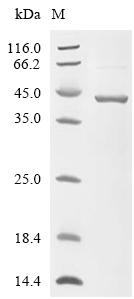
  • (Tris-Glycine gel) Discontinuous SDS-PAGE (reduced) with 5% enrichment gel and 15% separation gel.
Have Questions? Leave a Message or Start an on-line Chat

Product Details

Purity
≥90% as determined by SDS-PAGE.
Activity
Not Test
Target Names
Uniprot No.
Research Area
Metabolism
Alternative Names
Protein phosphatase 1C catalytic subunit
Species
Mus musculus (Mouse)
Source
E.coli
Expression Region
2-323aa
Target Protein Sequence
ADIDKLNIDSIIQRLLEVRGSKPGKNVQLQENEIRGLCLKSREIFLSQPILLELEAPLKICGDIHGQYYDLLRLFEYGGFPPESNYLFLGDYVDRGKQSLETICLLLAYKIKYPENFFLLRGNHECASINRIYGFYDECKRRYNIKLWKTFTDCFNCLPIAAIVDEKIFCCHGGLSPDLQSMEQIRRIMRPTDVPDQGLLCDLLWSDPDKDVLGWGENDRGVSFTFGAEVVAKFLHKHDLDLICRAHQVVEDGYEFFAKRQLVTLFSAPNYCGEFDNAGAMMSVDETLMCSFQILKPAEKKKPNATRPVTPPRGMITKQAKK
Note: The complete sequence may include tag sequence, target protein sequence, linker sequence and extra sequence that is translated with the protein sequence for the purpose(s) of secretion, stability, solubility, etc.
If the exact amino acid sequence of this recombinant protein is critical to your application, please explicitly request the full and complete sequence of this protein before ordering.
Mol. Weight
43.8 kDa
Protein Length
Full Length of Mature Protein
Tag Info
C-terminal 6xHis-tagged
Form
Liquid or Lyophilized powder
Note: We will preferentially ship the format that we have in stock, however, if you have any special requirement for the format, please remark your requirement when placing the order, we will prepare according to your demand.
Buffer
If the delivery form is liquid, the default storage buffer is Tris/PBS-based buffer, 5%-50% glycerol. If the delivery form is lyophilized powder, the buffer before lyophilization is Tris/PBS-based buffer, 6% Trehalose, pH 8.0.
Reconstitution
We recommend that this vial be briefly centrifuged prior to opening to bring the contents to the bottom. Please reconstitute protein in deionized sterile water to a concentration of 0.1-1.0 mg/mL.We recommend to add 5-50% of glycerol (final concentration) and aliquot for long-term storage at -20℃/-80℃. Our default final concentration of glycerol is 50%. Customers could use it as reference.
Troubleshooting and FAQs
Storage Condition
Store at -20°C/-80°C upon receipt, aliquoting is necessary for mutiple use. Avoid repeated freeze-thaw cycles.
Shelf Life
The shelf life is related to many factors, storage state, buffer ingredients, storage temperature and the stability of the protein itself.
Generally, the shelf life of liquid form is 6 months at -20°C/-80°C. The shelf life of lyophilized form is 12 months at -20°C/-80°C.
Lead Time
Basically, we can dispatch the products out in 3-7 working days after receiving your orders. Delivery time may differ from different purchasing way or location, please kindly consult your local distributors for specific delivery time.
Notes
Repeated freezing and thawing is not recommended. Store working aliquots at 4℃ for up to one week.
Datasheet & COA
Please contact us to get it.
Customer Reviews and Q&A

 Customer Reviews

There are currently no reviews for this product.

Submit a Review here

Target Background

Function
Protein phosphatase that associates with over 200 regulatory proteins to form highly specific holoenzymes which dephosphorylate hundreds of biological targets. Protein phosphatase 1 (PP1) is essential for cell division, and participates in the regulation of glycogen metabolism, muscle contractility and protein synthesis. Dephosphorylates RPS6KB1. Involved in regulation of ionic conductances and long-term synaptic plasticity. May play an important role in dephosphorylating substrates such as the postsynaptic density-associated Ca(2+)/calmodulin dependent protein kinase II. Component of the PTW/PP1 phosphatase complex, which plays a role in the control of chromatin structure and cell cycle progression during the transition from mitosis into interphase. In balance with CSNK1D and CSNK1E, determines the circadian period length, through the regulation of the speed and rhythmicity of PER1 and PER2 phosphorylation. May dephosphorylate CSNK1D and CSNK1E.; Required for normal male fertility.
Gene References into Functions
  1. These findings provide novel evidence for a role of miRNAs in memory formation and suggest the implication of PP1 in miRNAs processing in the adult brain. PMID: 27558292
  2. The interaction between PPP1CC2 and AKAP4 in human spermatozoa. PMID: 27913189
  3. DNA modification methylase inhibitor 5-aza-2'-deoxycytidine restrains the expression of PP1gamma which is related to learning and memory in mice. PMID: 27665473
  4. PP1 directly interacts with IRF3 and dephosphorylates IRF3 at Ser385 and Ser396, resulting in the suppression of TLR- and RLR-triggered IFN-beta production. PMID: 25239187
  5. The endogenous Ppp1cc promoter normally functions in the testis to maintain a sufficient level of PPP1CC2 expression for normal spermatogenesis to occur. PMID: 23082183
  6. In mouse testis, PPP1CC2 can form a complex with TSSK1 mediated by the direct interaction of each with the kinase substrate protein TSKS. Interaction between PPP1CC2 and TSKS is mediated through an RVxF docking motif on the TSKS surface. PMID: 24088291
  7. Spermatogenic defects observed in the global Ppp1cc knockout mice and in mice expressing low levels of PPP1CC2 in testis are due to compromised functions of PPP1CC2 in meiotic and postmeiotic germ cells. PMID: 24089200
  8. PP1cgamma mutant sperm are unable to support development to the blastocyst stage, resulting in arrested development either before or just after compaction. PMID: 12606345
  9. The present study focused on TGF-beta-modulation of paxillin and the serine/threonine protein phosphatase PP-1, and the impact on cellular motility. PMID: 21965722
  10. Results identify protein phosphatase 1 (PP1) as regulator of period and light-induced resetting of the mammalian circadian clock. PMID: 21712997
  11. Present results demonisterated that not only phosphorylation but also dephosphorylation is a major mechanism involved in learning and memory. Therefore, inhibition of hippocampal phosphatase activity might improve learning and memory. PMID: 20299813
  12. glutamate receptors type 1a, 5a, and 5b bind to protein phosphatase 1C PMID: 14519764
  13. there is a protein phosphatase-1gamma1 isoform selectivity determinant in dendritic spine-associated neurabin PMID: 15016827
  14. the interaction between Spz1 and PP1cgamma2 may be required for proper regulation of spermatogenesis and fertility in males PMID: 15226296
  15. PP1gamma2 is involved in sperm tail morphogenesis. PMID: 17301292
  16. Ppp1cc was identified in the study. PMID: 17683050
  17. The in vivo consequences of disrupting the G(L)-phosphorylase a interaction, using a mouse model containing a Tyr284Phe substitution in the phosphorylase a-binding region of the hepatic glycogen-associated protein phosphatase-1 protein, is reported. PMID: 19275933
  18. Ikaros is controlled by the CK2 and PP1 pathways and that a balance between these two signal transduction pathways is essential for normal cellular function and for the prevention of malignant transformation. PMID: 19282287
  19. Data show a reciprocal relationship between protein phosphatase isoform PP1gamma2 and its regulator PPP1R11, and suggest that complex formation between them in testis may prevent proteolysis of PPP1R11 and germ cell apoptosis. PMID: 19300506
  20. Dab2 stabilizes Axin and attenuates Wnt/beta-catenin signaling by preventing PP1 from binding Axin PMID: 19581931

Show More

Hide All

Subcellular Location
Cytoplasm. Nucleus. Cleavage furrow. Nucleus, nucleolus. Nucleus, nucleoplasm. Chromosome, centromere, kinetochore. Nucleus speckle. Midbody. Mitochondrion. Cytoplasm, cytoskeleton, microtubule organizing center.
Protein Families
PPP phosphatase family, PP-1 subfamily
Tissue Specificity
Isoform 1 is widely expressed. Isoform 2 is highly enriched in testis, mainly restricted to meiotic and postmeiotic germ cells.
Database Links
icon of phone
Call us
301-363-4651 (Available 9 a.m. to 5 p.m. CST from Monday to Friday)
icon of address
Address
No. 269, Shendun 5th Road, Donghu Hi-Tech Development Area, Hubei Province, 430206, P.R.China
icon of social media
Join us with

Subscribe newsletter

Leave a message

* To protect against spam, please pass the CAPTCHA test below.
CAPTCHA verification
© 2007-2026 CUSABIO TECHNOLOGY LLC All rights reserved. 鄂ICP备15011166号-1
Place an order now

I. Product details

*
*
*
*

II. Contact details

*
*

III. Ship To

*
*
*
*
*
*
*

IV. Bill To

*
*
*
*
*
*
*
*



