
Call us
301-363-4651 (Available 9 a.m. to 5 p.m. CST from Monday to Friday)

| Code | CSB-RA144588A0HU |
| Size | US$210 |
| Order now | |
| Image |
|
| Have Questions? | Leave a Message or Start an on-line Chat |
| Application | Recommended Dilution |
|---|---|
| WB | 1:500-1:5000 |
| FC | 1:50-1:200 |
ACTR2, also known as actin-related protein 2, serves as an essential component of the Arp2/3 complex, a molecular machine that drives actin filament nucleation and branching. This protein plays a fundamental role in cytoskeletal dynamics, influencing cellular processes ranging from cell migration and membrane protrusion to endocytosis and intracellular trafficking. For researchers investigating signal transduction pathways and cytoskeletal regulation, reliable detection of ACTR2 provides valuable insights into these interconnected cellular mechanisms.
This recombinant monoclonal antibody, clone 25C9, offers the consistency and reproducibility that demanding experimental workflows require. Generated using recombinant technology with a defined sequence, this rabbit IgG delivers lot-to-lot uniformity that traditional hybridoma-derived antibodies cannot match. Researchers can confidently compare results across extended studies knowing the antibody performance remains stable.
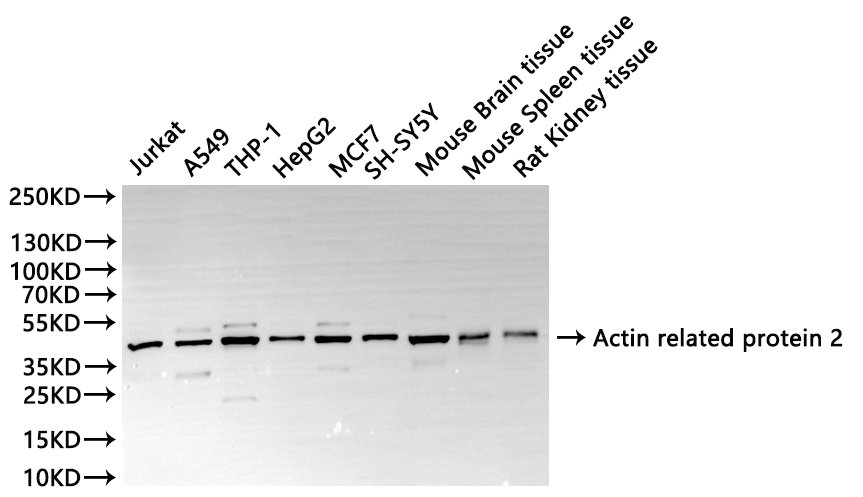
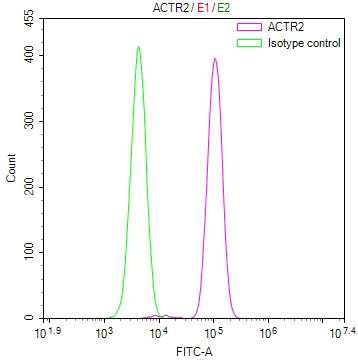
Validation data demonstrates robust performance across multiple applications and sample types. In western blot analysis, the antibody detects a clean band at the predicted 45 kDa molecular weight across diverse human cell lines including Jurkat, A549, THP-1, HepG2, MCF7, and SH-SY5Y cells. Cross-species reactivity extends to rodent samples, with confirmed detection in mouse brain and spleen tissues as well as rat kidney lysate, providing flexibility for researchers working with animal models. Flow cytometry validation in Jurkat cells shows clear positive signal separation from isotype controls, confirming utility for intracellular protein quantification studies.
Whether investigating actin cytoskeleton remodeling, cell motility mechanisms, or broader signal transduction networks, this antibody provides a dependable tool for exploring ACTR2 biology across human and rodent experimental systems.
There are currently no reviews for this product.





