
Call us
301-363-4651 (Available 9 a.m. to 5 p.m. CST from Monday to Friday)

| Code | CSB-RA263831A0HU |
| Size | US$210 |
| Order now | |
| Image |
|
| Have Questions? | Leave a Message or Start an on-line Chat |
| Application | Recommended Dilution |
|---|---|
| IHC | 1:50-1:200 |
Angiotensinogen serves as the essential precursor in the renin-angiotensin system, undergoing sequential proteolytic cleavage to generate the bioactive angiotensin peptides that regulate blood pressure, fluid balance, and tissue remodeling. As the upstream substrate for this critical cascade, AGT expression and processing directly influence cardiovascular physiology and pathology, making it a key target for researchers investigating hypertension, kidney disease, and metabolic disorders.
This recombinant monoclonal antibody, clone 8A9, offers the reproducibility and consistency that demanding research protocols require. Developed using recombinant technology with a sequence-defined rabbit IgG format, it eliminates the lot-to-lot variability inherent in traditional hybridoma-derived antibodies. The defined molecular composition ensures that your experimental conditions remain stable across studies, supporting reliable data generation whether you are conducting preliminary screens or building on established findings.
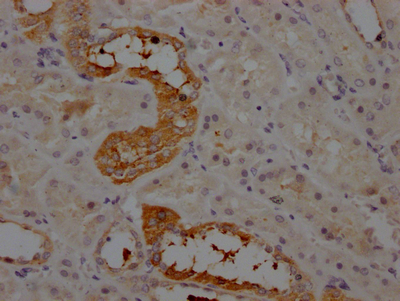
Validation in immunohistochemistry demonstrates effective detection of AGT in paraffin-embedded human kidney tissue, a physiologically relevant sample type given the kidney's central role in angiotensinogen production and renin-angiotensin system activity. The recommended working dilution range of 1:50 to 1:200 for IHC provides flexibility to optimize signal intensity based on your specific tissue preparation and detection system. Additional validation for ELISA applications extends the utility of this antibody across different experimental workflows.
Raised against a synthetic peptide derived from human angiotensinogen and affinity-purified for enhanced specificity, this antibody supports investigations spanning cardiovascular biology, metabolic regulation, and signal transduction pathways. Researchers studying the renin-angiotensin system's contributions to disease pathophysiology will find this reagent well-suited for characterizing AGT expression patterns in human tissues.
There are currently no reviews for this product.





