
Call us
301-363-4651 (Available 9 a.m. to 5 p.m. CST from Monday to Friday)

| Code | CSB-RA178469A0HU |
| Size | US$210 |
| Order now | |
| Image |
|
| Have Questions? | Leave a Message or Start an on-line Chat |
| Application | Recommended Dilution |
|---|---|
| WB | 1:500-1:2000 |
| IF | 1:50-1:200 |
| FC | 1:50-1:200 |
BAG6, also known as BCL2-associated athanogene 6 or HLA-B-associated transcript 3, serves as a critical molecular chaperone regulator involved in protein quality control pathways. This multifunctional protein plays essential roles in the targeting of tail-anchored proteins to the endoplasmic reticulum, regulation of apoptosis, and modulation of immune responses through its association with MHC class I molecules. Its involvement in protein homeostasis and cellular stress responses makes BAG6 a significant target for researchers investigating proteostasis, cancer biology, and immunology.
This recombinant monoclonal antibody, clone 5H6, offers the consistency and reproducibility that demanding experimental workflows require. Produced using recombinant technology with a sequence-defined rabbit IgG format, it eliminates the lot-to-lot variability that can compromise longitudinal studies or multi-site collaborations. The antibody was raised against a synthesized peptide derived from human BAG6 and demonstrates cross-species reactivity with both human and mouse samples.
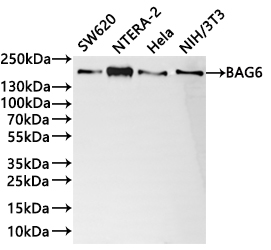
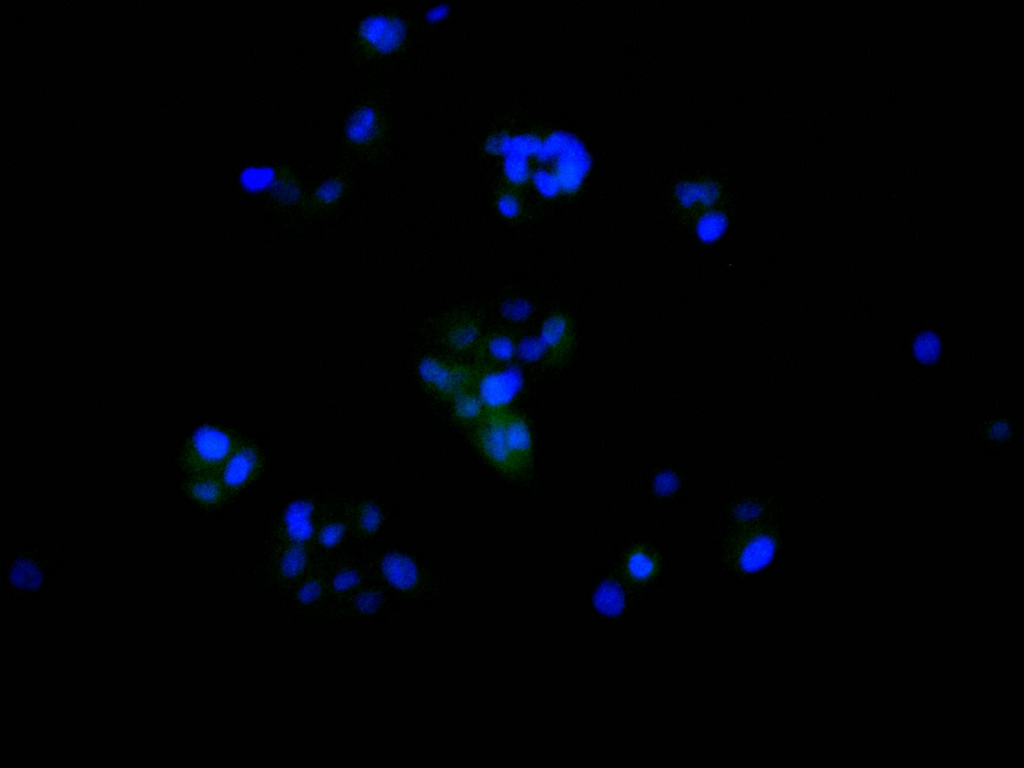
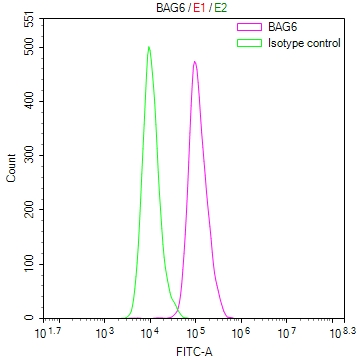
Validation across multiple platforms confirms this antibody's versatility in your research toolkit. Western blot analysis successfully detects BAG6 in human cell lines including SW620, NTERA-2, and HeLa, as well as mouse NIH/3T3 cells, with optimal performance at 1:500–1:2000 dilutions. The observed band at approximately 160 kDa, higher than the predicted 119 kDa molecular weight, likely reflects post-translational modifications such as glycosylation or the protein's proline-rich composition affecting gel migration. Immunofluorescence staining in HepG2 cells and flow cytometry analysis in K562 cells further demonstrate reliable performance for cellular localization and quantitative expression studies.
This antibody supports investigations into protein quality control mechanisms, ER-associated degradation pathways, and immune regulation research.
There are currently no reviews for this product.





