
Call us
301-363-4651 (Available 9 a.m. to 5 p.m. CST from Monday to Friday)

| Code | CSB-RA968730A0HU |
| Size | US$210 |
| Order now | |
| Image |
|
| Have Questions? | Leave a Message or Start an on-line Chat |
| Application | Recommended Dilution |
|---|---|
| FC | 1:50-1:200 |
Caspase-10 plays a pivotal role in the extrinsic apoptotic pathway, functioning as an initiator caspase that responds to death receptor signaling through the Fas-associated death domain protein complex. As a key mediator of programmed cell death, CASP10 has garnered significant research interest in studies of immune regulation, cancer biology, and autoimmune lymphoproliferative syndrome, where mutations in this gene have been implicated in disease pathogenesis.
This recombinant monoclonal antibody, developed using clone 23F8, offers researchers the reproducibility and consistency that only sequence-defined antibodies can provide. Because the antibody sequence is fixed and produced in a controlled recombinant system, you can expect identical performance across different lots, eliminating the variability that often complicates long-term studies or multi-site collaborations. The rabbit host origin combined with affinity chromatography purification ensures high specificity for the human CASP10 epitope derived from a synthesized peptide immunogen.
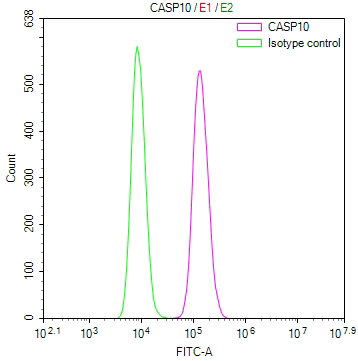
Validation studies using flow cytometry demonstrate clear detection of CASP10 in K562 human chronic myelogenous leukemia cells. The overlay histogram shows distinct separation between the specific signal and isotype control when cells were fixed, permeabilized, and stained at a 1:100 dilution, confirming reliable intracellular detection of this apoptotic protease. The antibody has been tested for both ELISA and flow cytometry applications, with recommended dilutions of 1:50 to 1:200 for flow cytometric analysis, giving you flexibility to optimize detection in your specific experimental system.
For researchers investigating apoptotic signaling cascades, death receptor pathways, or caspase activation dynamics in human cell models, this antibody provides a dependable tool for characterizing CASP10 expression and function.
There are currently no reviews for this product.





