CASP5 Recombinant Monoclonal Antibody

Code CSB-RA224345A0HU
Size US$210
Order now
Image
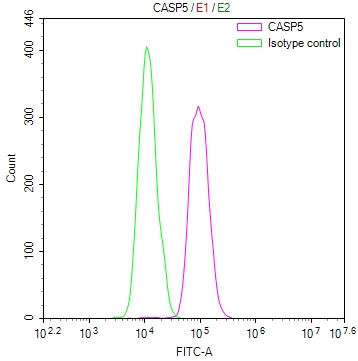
  • Overlay Peak curve showing HepG2 cells stained with CSB-RA224345A0HU (red line) at 1:100. The cells were fixed in 4% formaldehyde and permeated by 0.2% TritonX-100 for 10min. Then 10% normal goat serum to block non-specific protein-protein interactions followed by the antibody (1ug/1*106cells) for 45min at 4℃. The secondary antibody used was FITC-conjugated goat anti-rabbit IgG (H+L) at 1/200 dilution for 35min at 4℃.Control antibody (green line) was Rabbit IgG (1ug/1*106cells) used under the same conditions. Acquisition of >10,000 events was performed.
Have Questions? Leave a Message or Start an on-line Chat

Product Details

Uniprot No.
Target Names
Alternative Names
Caspase-5 (CASP-5) (EC 3.4.22.58) (ICE(rel)-III) (Protease ICH-3) (Protease TY) [Cleaved into: Caspase-5 subunit p20, Caspase-5 subunit p10], CASP5, ICH3
Species Reactivity
Human
Immunogen
A synthesized peptide from human CASP5 protein
Immunogen Species
Homo sapiens (Human)
Conjugate
Non-conjugated
Clonality
Monoclonal
Isotype
Rabbit IgG
Clone No.
9B2
Purification Method
Affinity-chromatography
Concentration
It differs from different batches. Please contact us to confirm it.
Buffer
Rabbit IgG in 10mM phosphate buffered saline , pH 7.4, 150mM sodium chloride, 0.05% BSA, 0.02% sodium azide and 50% glycerol.
Form
Liquid
Tested Applications
ELISA, FC
Recommended Dilution
Application Recommended Dilution
FC 1:50-1:200
Troubleshooting and FAQs
Storage
Upon receipt, store at -20°C or -80°C. Avoid repeated freeze.
Lead Time
Basically, we can dispatch the products out in 1-3 working days after receiving your orders. Delivery time maybe differs from different purchasing way or location, please kindly consult your local distributors for specific delivery time.
Description

Caspase-5 plays a central role in inflammatory signaling pathways, functioning as a key component of the inflammasome complex where it processes pro-inflammatory cytokines and contributes to pyroptotic cell death. This inflammatory caspase has garnered significant research attention for its involvement in innate immune responses, particularly in the context of bacterial infection sensing and inflammatory disease pathogenesis. Understanding CASP5 activity and expression patterns provides valuable insights into mechanisms underlying conditions ranging from sepsis to inflammatory bowel disease.

This recombinant monoclonal antibody, clone 9B2, offers researchers the reproducibility advantages inherent to recombinant technology. Because the antibody sequence is defined and produced from a stable expression system, you can expect consistent performance across experiments and over time, eliminating the lot-to-lot variability that can complicate long-term studies or multi-site collaborations. The rabbit IgG format, purified by affinity chromatography, ensures high specificity for your target.

Validation for flow cytometry applications has been performed using HepG2 cells, demonstrating clear separation between specific staining and isotype control populations. The recommended working dilution range of 1:50 to 1:200 for flow cytometry provides flexibility to optimize signal intensity based on your specific experimental conditions and instrument sensitivity. The antibody has also been validated for ELISA applications, supporting quantitative detection workflows.

Supplied in a glycerol-containing buffer optimized for long-term stability at -20°C or -80°C, this antibody is well-suited for researchers investigating inflammasome biology, inflammatory caspase cascades, or pyroptosis mechanisms in human cell systems. Its defined specificity for human CASP5 makes it a reliable tool for characterizing inflammatory pathway activation in disease-relevant models.

Usage
For Research Use Only. Not for use in diagnostic or therapeutic procedures.

Customer Reviews and Q&A

 Customer Reviews

There are currently no reviews for this product.

Submit a Review here

Target Background

Function
Thiol protease that acts as a mediator of programmed cell death. Initiates pyroptosis, a programmed lytic cell death pathway through cleavage of Gasdermin-D (GSDMD): cleavage releases the N-terminal gasdermin moiety (Gasdermin-D, N-terminal) that binds to membranes and forms pores, triggering pyroptosis. During non-canonical inflammasome activation, cuts CGAS and may play a role in the regulation of antiviral innate immune activation.
Gene References into Functions
  1. Long non-coding RNA CASP5 promotes the malignant phenotypes of human glioblastoma multiforme. PMID: 29715460
  2. Study shows that CASP5 was positively correlated with inflammation in rheumatoid arthritis (RA), and provides evidence that certain CASP5 SNPs were associated with an increased risk of RA. PMID: 29158166
  3. Th17 micro-milieu via IL-17A regulates NLRP1-dependent CASP5 activity in psoriatic skin autoinflammation. PMID: 28422993
  4. CASP5 gene overexpression significantly promoted angiogenesis ability of HMEC-1 cells, which was probably achieved by inhibiting angpt-1/Tie2 and promoting VEGF-1 signal pathway. PMID: 26884849
  5. The distribution of the other genotypes; rs507879, rs518604 and rs523104 of caspase-5) was not significantly different between patients with psoriasis vulgaris and the healthy controls. PMID: 25753570
  6. Data show that exposure of hepatocytes to direct hypoxia resulted in acid sphingomyelinase activation and ceramide elevation associated with activation of caspase 5 and the subsequent cleavage of HuR and apoptotic cell death. PMID: 22906436
  7. Mutual activation between caspase-5 and -1 suggests caspase-5 may work predominantly in concert with caspase-1 in modulating retinal pigment epithelium inflammatory responses. PMID: 21969293
  8. analysis of concerted antigen processing of a short viral antigen by human caspase-5 and -10 PMID: 21454616
  9. Caspase-5 and the inflammasome may have an important role in the inflammatory response in psoriasis. PMID: 21191419
  10. Unfavorable significance of CASP5 heterozygous genotype explained by its role in inflammation-related processes. PMID: 20434535
  11. Identification of caspase-5 coding region microsatellite mutations in vivo implicates this gene in the pathogenesis of human T-LBL/ALL PMID: 12479849
  12. Caspase-5 might be a suppressor gene of highly metastatic potential in lung cancer PMID: 12964016
  13. CASPASE-5, an acknowledged frameshift target in MSI+ gastrointestinal tract tumors, was frequently mutated in Microsatellite instability+ cell lines PMID: 15886296
  14. novel exon was present in six alternatively spliced caspase-5 mRNA variants expressed in human peripheral blood mononuclear cells (PBMC) and encoded the previously unknown amino-terminus of caspase-5. PMID: 16893518
  15. Caspase-5 gene is commonly mutated in the cancers with microsatellite instability suggesting that inactivation of caspase-5 may play a role in their tumorigenesis. PMID: 18430458
  16. Coding polymorphisms in Casp5, Casp8 and DR4 genes may play a role in predisposition to lung cancer. PMID: 19203830
  17. Single nucleotide polymorphisms in CASP5 and RBBP8 gene are associated with survival in ovarian cancer patients. PMID: 19270026

Show More

Hide All

Protein Families
Peptidase C14A family
Tissue Specificity
Expressed in barely detectable amounts in most tissues except brain, highest levels being found in lung, liver and skeletal muscle.
Database Links

HGNC: 1506

OMIM: 602665

KEGG: hsa:838

STRING: 9606.ENSP00000376849

UniGene: Hs.213327

icon of phone
Call us
301-363-4651 (Available 9 a.m. to 5 p.m. CST from Monday to Friday)

icon of address
Address
No. 269, Shendun 5th Road, Donghu Hi-Tech Development Area, Hubei Province, 430206, P.R.China
icon of social media
Join us with

Subscribe newsletter

Leave a message

* To protect against spam, please pass the CAPTCHA test below.
CAPTCHA verification
© 2007-2026 CUSABIO TECHNOLOGY LLC All rights reserved. 鄂ICP备15011166号-1
Place an order now

I. Product details

*
*
*
*

II. Contact details

*
*

III. Ship To

*
*
*
*
*
*
*

IV. Bill To

*
*
*
*
*
*
*
*


