

Call us
301-363-4651 (Available 9 a.m. to 5 p.m. CST from Monday to Friday)

| Code | CSB-RA970319A0HU |
| Size | US$210 |
| Order now | |
| Image |
|
| Have Questions? | Leave a Message or Start an on-line Chat |
| Application | Recommended Dilution |
|---|---|
| WB | 1:500-1:2000 |
| IHC | 1:50-1:200 |
| FC | 1:50-1:200 |
CRMP1, also known as dihydropyrimidinase-related protein 1, plays a fundamental role in neuronal development and axon guidance. As a member of the collapsin response mediator protein family, CRMP1 mediates semaphorin signaling pathways that direct growth cone collapse and neuronal migration during nervous system formation. Beyond development, CRMP1 has emerged as a protein of interest in neurodegenerative disease research and studies of neuronal plasticity, making reliable detection tools essential for investigators working in these areas.
This recombinant monoclonal antibody, generated from clone 17E7, offers the consistency and reproducibility that demanding neuroscience research requires. Because the antibody sequence is defined and produced recombinantly in rabbit host, you can expect uniform performance across experiments and between lot numbers, eliminating a common source of variability in longitudinal studies. The monoclonal nature ensures recognition of a single epitope on the CRMP1 protein, providing specificity that supports confident data interpretation.
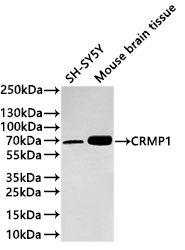
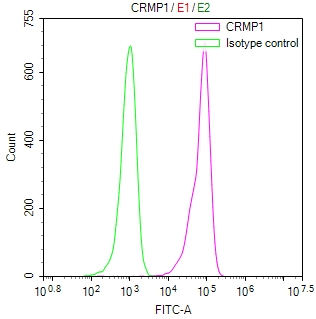
Validation studies demonstrate robust performance across multiple experimental platforms. Western blot analysis detects CRMP1 at the expected 62 kDa molecular weight in both human SH-SY5Y neuroblastoma cells and mouse brain tissue lysates, confirming cross-species reactivity and suitability for comparative studies. Immunohistochemistry on paraffin-embedded human brain tissue reveals clear staining patterns, while flow cytometry analysis in SH-SY5Y cells shows distinct positive signal separation from isotype controls, enabling quantitative assessment of CRMP1 expression at the single-cell level.
Whether investigating axon guidance mechanisms, characterizing neuronal differentiation, or exploring CRMP1 dysregulation in neurological disorders, this antibody provides the versatility and reliability needed to advance your research with confidence.
There are currently no reviews for this product.





