
Call us
301-363-4651 (Available 9 a.m. to 5 p.m. CST from Monday to Friday)

| Code | CSB-RA066000A0HU |
| Size | US$210 |
| Order now | |
| Image |
|
| Have Questions? | Leave a Message or Start an on-line Chat |
| Application | Recommended Dilution |
|---|---|
| WB | 1:500-1:5000 |
| IHC | 1:50-1:200 |
DDB1 (DNA damage-binding protein 1) serves as a critical scaffold protein within the CUL4-DDB1 ubiquitin ligase complex, playing essential roles in nucleotide excision repair, DNA replication, and cell cycle regulation. As a key component of the UV-damaged DNA-binding factor, DDB1 recognizes and binds to UV-induced DNA lesions, initiating the repair cascade that maintains genomic integrity. Its involvement in multiple cellular processes, including chromatin remodeling and viral protein interactions (notably with hepatitis B virus X protein), makes DDB1 a significant target for cancer biology, DNA repair research, and studies of viral pathogenesis.
This recombinant monoclonal antibody (clone 6E2) offers the reproducibility and consistency that demanding research applications require. Generated against a synthetic peptide derived from human DDB1, the antibody is produced using recombinant technology, ensuring sequence-defined specificity and eliminating the lot-to-lot variability that can compromise longitudinal studies or multi-site collaborations.
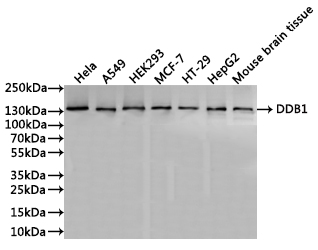
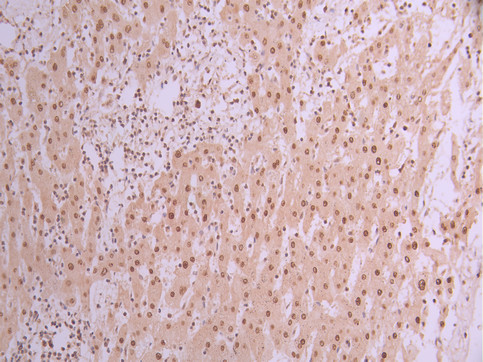
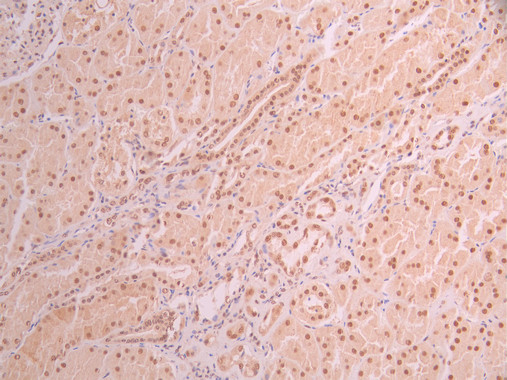
Validation studies demonstrate robust performance across multiple experimental platforms. Western blot analysis detects DDB1 at the expected molecular weight range (observed at approximately 130 kDa, slightly higher than the predicted 127 kDa, likely reflecting post-translational modifications such as phosphorylation) across diverse human cell lines including HeLa, A549, HEK293, MCF-7, HT-29, and HepG2, as well as mouse brain tissue, confirming cross-species reactivity. Immunohistochemistry applications have been validated in paraffin-embedded human liver cancer and kidney tissues using citrate buffer antigen retrieval, with recommended dilutions of 1:50–1:200 providing flexibility for optimization across different tissue types.
This antibody is well-suited for researchers investigating DNA damage response pathways, ubiquitin-proteasome regulation, and cancer-associated mechanisms where DDB1 dysfunction contributes to disease progression.
There are currently no reviews for this product.





