
Call us
301-363-4651 (Available 9 a.m. to 5 p.m. CST from Monday to Friday)

| Code | CSB-RA080723A0HU |
| Size | US$210 |
| Order now | |
| Image |
|
| Have Questions? | Leave a Message or Start an on-line Chat |
| Application | Recommended Dilution |
|---|---|
| WB | 1:500-1:5000 |
| IHC | 1:50-1:200 |
| FC | 1:50-1:200 |
DIAPH1, also known as Diaphanous-related formin-1, plays a central role in actin cytoskeleton remodeling and microtubule stabilization, making it essential for processes including cell division, migration, and morphogenesis. Mutations in this gene are associated with autosomal dominant deafness (DFNA1), positioning DIAPH1 as a significant target for researchers investigating signal transduction pathways, cytoskeletal dynamics, and hearing loss mechanisms.
This recombinant monoclonal antibody, generated in rabbit and designated clone 20F8, offers the consistency and reproducibility that demanding experimental workflows require. Because recombinant antibodies are produced from defined sequences rather than traditional hybridoma methods, researchers benefit from lot-to-lot uniformity, ensuring that results remain comparable across extended studies and collaborative projects.
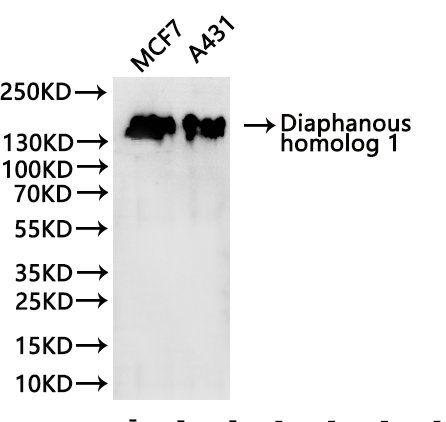
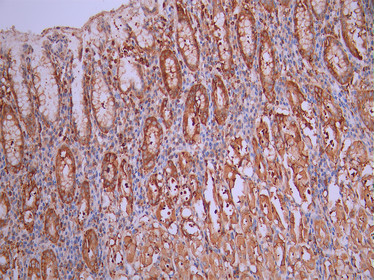
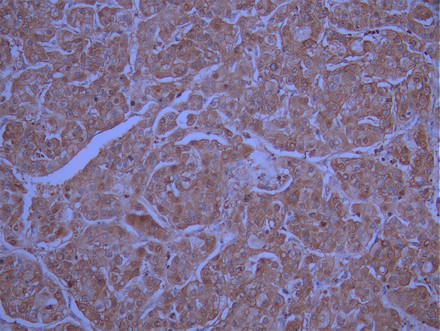
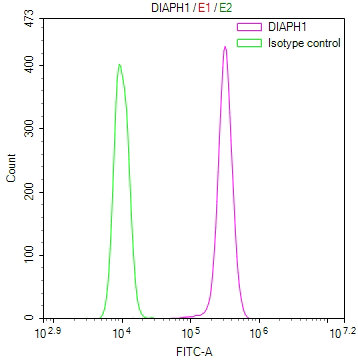
Validation data demonstrate reliable performance across multiple applications. In Western blot experiments, the antibody detects DIAPH1 in MCF7 and A431 whole cell lysates at dilutions ranging from 1:500 to 1:5000, producing a band at approximately 150 kDa. The slight difference from the predicted molecular weight of 141 kDa likely reflects post-translational modifications such as glycosylation, which are common for proteins of this size and function. For tissue-based studies, immunohistochemistry has been validated in paraffin-embedded human stomach tissue and human liver cancer sections using citrate buffer antigen retrieval at 1:100 dilution. Flow cytometry applications have been confirmed using HeLa cells with clear positive signal separation from isotype controls.
Whether you are exploring cytoskeletal regulation, investigating DIAPH1's role in cancer biology, or studying hereditary hearing disorders, this antibody provides the specificity and application flexibility needed to advance your research with confidence.
There are currently no reviews for this product.





