
Call us
301-363-4651 (Available 9 a.m. to 5 p.m. CST from Monday to Friday)

| Code | CSB-RA297176A0HU |
| Size | US$210 |
| Order now | |
| Image |
|
| Have Questions? | Leave a Message or Start an on-line Chat |
| Application | Recommended Dilution |
|---|---|
| WB | 1:500-1:2000 |
| FC | 1:50-1:200 |
Disrupted in schizophrenia 1 (DISC1) represents one of the most compelling risk factors for major psychiatric disorders, with genetic disruptions linked to schizophrenia, bipolar disorder, and major depression. This multifunctional scaffolding protein plays essential roles in neurodevelopmental processes including neuronal migration, neurite outgrowth, and synaptic regulation, making it a critical target for researchers investigating the molecular underpinnings of mental illness and brain development.
This recombinant monoclonal antibody, generated against a synthetic peptide derived from human DISC1, offers the reproducibility and consistency that demanding neuroscience research requires. As a sequence-defined recombinant clone, it eliminates the lot-to-lot variability that can compromise longitudinal studies, ensuring your experimental conditions remain constant across projects spanning months or years.
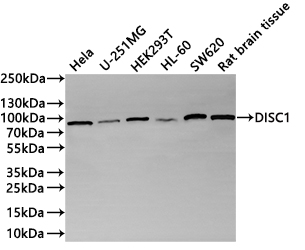
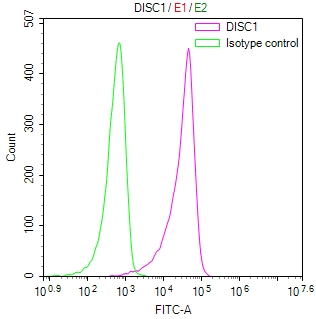
Validation studies demonstrate reliable performance across multiple experimental platforms. In western blot applications, the antibody detects DISC1 in diverse human cell lines including HeLa, U-251MG glioblastoma, HEK293T, HL-60, and SW620 cells, as well as rat brain tissue lysate, confirming cross-species reactivity valuable for translational studies. The observed 115 kDa Western Blot band (larger than the predicted 100 kDa) for the recombinant monoclonal anti-DISC1 antibody reflects recognition of the actual expressed DISC1 isoform—either a longer variant via alternative splicing (inserting extra exons) or a post-translationally modified (e.g., glycosylated) form—whose increased mass (115 kDa) exceeds the theoretical 100 kDa full-length/precursor size. Flow cytometry validation in Jurkat cells demonstrates clear positive signal separation from isotype controls, supporting intracellular detection applications.
Whether you are mapping DISC1 protein interaction networks, investigating its role in neural progenitor cell biology, or exploring psychiatric disease mechanisms, this antibody provides a dependable tool for advancing your understanding of this pivotal neurodevelopmental regulator.
There are currently no reviews for this product.





