
Call us
301-363-4651 (Available 9 a.m. to 5 p.m. CST from Monday to Friday)

| Code | CSB-RA019747A0HU |
| Size | US$210 |
| Order now | |
| Image |
|
| Have Questions? | Leave a Message or Start an on-line Chat |
| Application | Recommended Dilution |
|---|---|
| WB | 1:500-1:2000 |
| IF | 1:50-1:200 |
| FC | 1:50-1:200 |
Eukaryotic translation elongation factor 1 alpha 1 (EEF1A1) serves as a fundamental component of the protein synthesis machinery, delivering aminoacyl-tRNAs to the ribosome during translation. Beyond its canonical role in protein biosynthesis, EEF1A1 has emerged as a multifunctional protein implicated in cytoskeletal organization, signal transduction, and cell proliferation. Its elevated expression in various cancers, including prostate and cervical malignancies, has positioned it as a protein of significant interest in oncology research and studies of translational regulation.
This recombinant rabbit monoclonal antibody (clone 9C12) offers the reproducibility and consistency that demanding experimental workflows require. Generated against a synthetic peptide derived from human EEF1A1, the recombinant production method ensures sequence-defined specificity and eliminates the lot-to-lot variability that can compromise longitudinal studies or multi-site collaborations.
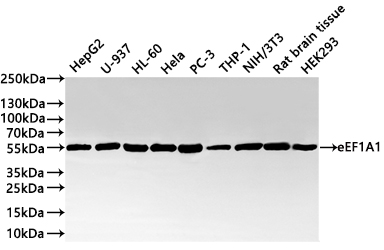
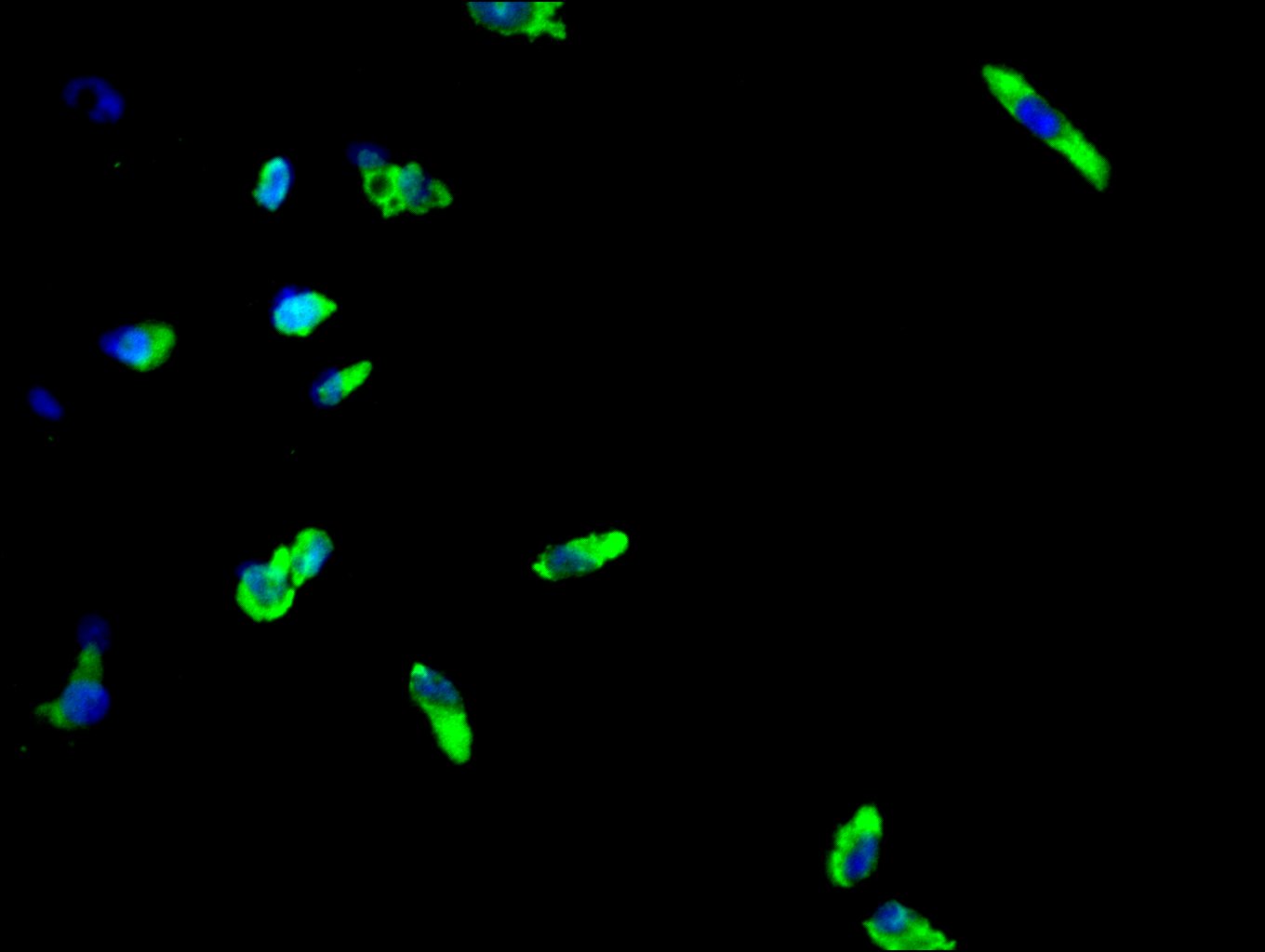
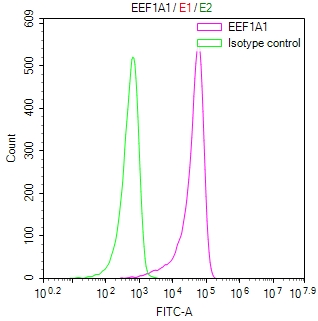
Validation across multiple platforms demonstrates the antibody's experimental versatility. Western blot analysis confirms robust detection in an extensive panel of human cell lines, including HepG2, U-937, HL-60, HeLa, PC-3, THP-1, and HEK293, as well as mouse NIH/3T3 cells and rat brain tissue, supporting cross-species reactivity for human, mouse, and rat samples. The observed band at approximately 55 kDa, slightly above the predicted 50 kDa molecular weight, likely reflects post-translational modifications characteristic of this highly expressed protein. Immunofluorescence staining in HepG2 cells and flow cytometry analysis in Jurkat cells further extend its utility for cellular localization and quantitative expression studies.
Whether investigating translational control mechanisms, exploring EEF1A1's non-canonical functions, or examining its dysregulation in disease contexts, this antibody provides a reliable tool for protein synthesis and cancer biology research.
There are currently no reviews for this product.





